The Bible version of God doesn’t ring true to me. I don’t believe in any traditional sort of God. I am not that sort of person who finds any purpose in worshipping or asking favors from invisible Beings. I don’t ascribe any emotions or sentience (certainly, no vindictiveness) to any Person or Thing that might have created our universe. How the universe came into being is beyond what I can know.
I do cherish my universe, though, and I realize that I am an incredibly tiny and incredibly ignorant part of it. Many fervent believers (though not all) would characterize my beliefs as “atheism” although that word, as commonly construed, would characterize me in a misleadingly cartoonish way.
Given my beliefs, most people would be surprised to hear that I sometimes go to church to be inspired and energized. What’s my secret? I go to church when no one else is there—I like to go to empty churches. When nothing else is going on other than one’s own breathing, meditating, thinking and writing, going to church can even be exhilarating.
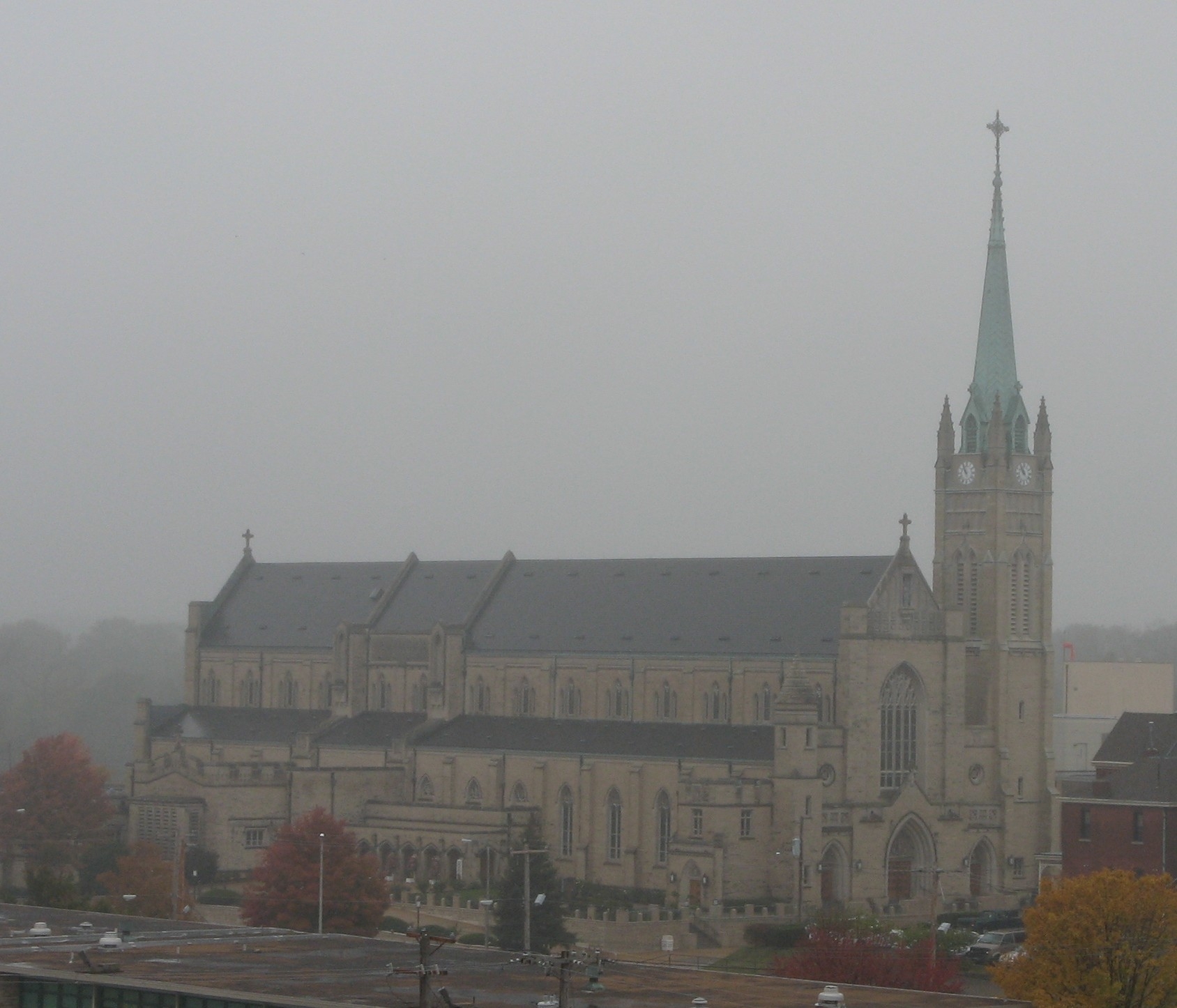
With a pad of paper and a pen in my hands, in search of solitude, I walked to church twice this week. I had previously noticed a huge church a few blocks from a courthouse where I sometimes work. Only after walking to this church on Monday did I learn that it was called “Saint Peter’s Roman Catholic Cathedral” in Belleville, Illinois. Here’s a photo I took on Wednesday (yes, a dreary looking day), just prior to my second “visit.”
The majestic interior of the church is also a treat to the eyes. The thick stone walls morph into the peak of the ceiling as they rise to meet each other 70 feet in the air.
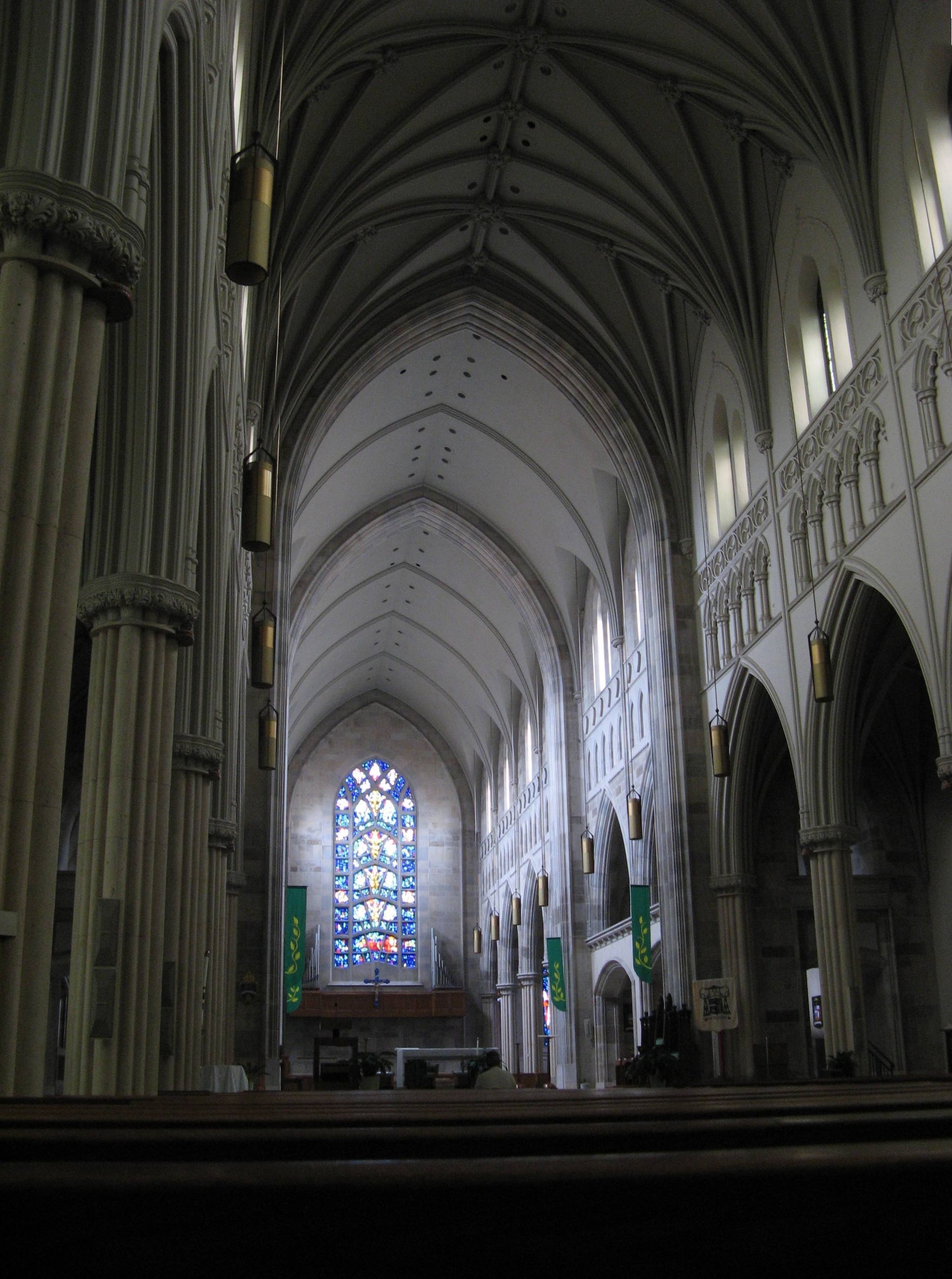
Even on a dreary day, the natural light works its way into every pew. Every tiny noise launches up into that vast inner-space like a dissipating butterfly. This incredible space, and the solitude it allows, more than make up for the musty church smell and the uncomfortable pews. We mustn’t complain about uncomfortable pews, we were told as children. After all, Jesus had nails driven through his hands for us.
When a church is empty, the overly-pious stained-glass images do not antagonize me. That’s because there are no real-life glassed-eyed adults standing over me to insist that the events depicted are historically accurate. When a church is empty, no one tells you to stand, then kneel, then stand again, then kneel again. No one tells you to chant out loud that a virgin had a baby. No one insists that chewing on a wafer is literally chewing on a man’s flesh–a man that was dead for three days but then supposedly wasn’t. No one is there to remind you that Christian beliefs are proven by an old book whose biggest fans are much more likely to clench it than read it. Or, if they actually read it, they cherry-pick it, ignoring anything inconvenient. Whether the Bible contains the actual words of God (as opposed to manipulative human beings), that is a topic best not appropriate to raise during church services.
As a boy, I rebelled against going to church services for all of these reasons. I always felt betrayed and confused by the things I was told to believe. Church-goers were temporary insane, it seemed. How could they say those things! Now, I work hard to restrain my frustration and suspicions. I now acknowledge that people attend church services to satisfy deep and ineffable cravings. Many of my writings at this site are attempts to better explore those cravings.
Not that all nonbelievers are repelled by Sunday morning liturgies. For example, Daniel Bennett writes the following in Breaking the Spell [1] (page 318):
[S]ome people seem impervious to religious ritual and all other manifestations of religion, whereas others-like me-are deeply moved by the ceremonies, the music, and the art-but utterly unpersuaded by the doctrines.
Despite my frustrating childhood experiences at church, a big empty church can still feel like “home” to me. Sitting in an empty church brings back some happy memories. I was an altar boy for three years while attending Catholic grade school. (No, I was never molested by a priest, although at least one of the priests for whom I served Mass was–many years later—sent off to prison). Whenever I sit in an empty church, it brings back memories of those many quiet times that I was alone in church, waiting for the priest to arrive, often at 5:45 in the morning. I passed the time by thinking and meditating. These are natural things to do in majestic quiet places like empty churches.
An empty church is welcoming, patient, forgiving and energizing, the opposite of the scripted, threatening and tedious services usually conducted there. In an empty church one is not urged to obscure one’s undeniable mortality with fancy words or ostentatious rituals. As it turns out, an empty church is a perfect place to write about the benefits of empty churches. It is a place to notice one’s own breathing and to hear one’s own simple questions, questions that (in my experience) haven’t been seriously understood or addressed by any member of any clergy for a half-century. In an empty church, the quiet causes one to remember all those things one does not know. In an empty church, no one is filling the place with incense or any sort of intellectual smoke.
Most people who go to church go there to attend scheduled services, not to scribble ideas on pads of paper. Nonetheless, traditional churchgoers also receive many of these same benefits I enjoy, at least while they wait for their church services to begin. Those quiet moments might be among the few moments each week when many people don’t have access to TV’s, radios and iPods. The quietude, thus unleashed, emerges to gently but inexorably compel thoughts regarding deep simple questions. I suspect that, for most believers, the pre-service silence is actually the most powerful part of being in a church. One is reminded of this great power of silence whenever a speaker inserts a long moment of silence into a crowded public event. The air becomes heavy and solemn in the absence of chatter. During moments of silence, even the rustling of a program or a cough is a blasphemy.
As I sat in the big empty cathedral, it occurred to me that going to organized church services offers great benefits to believers, even if God did not exist, and even during the service. Sitting in such a big building among people singing and chanting in unison can be compelling and mesmerizing. Being a part of a group that speaks and sings in together causes an invisible wave to well up and wash over the congregation. Acting together in unison, then, allows one to visualize the knitting the social fabric. It is a place where one can feel bonded with hundreds of people one does not really know. Spiritual instant-messaging.
During church services, individual needs and wants are somehow channeled into the potential for coordinated group action. Under various threats, regular attendance at church services is compelled; people show up week after week to pray along with other church members, even those with whom they are not well acquainted. Being together hits deep triggers in human animals. It creates emotional bonds that are sometimes strong enough to compel strangers to run to each other’s assistance when they are in need. When people pray together, they become brothers and sisters. I can’t help but compare the dedication that church members often show to each other to the lack of personal commitment among those who share ideas (even lofty humanitarian ideas), but don’t regularly and physically spend time together.
Taking the time to dress up and give up one’s Sunday morning is a powerful display of loyalty. As Zahavi [2]wrote, expensive signals are reliable. Giving up one’s Sunday morning to go to an uninspiring and repetitive recital of confusing claims is a very expensive signal indeed. It is also socially expensive to publicly advocate absurd positions, but there is a payback. Advocating that invisible beings care may not be true, but saying it out loud is an important signal of loyalty and dedication to all of those other church-goers who hear you.
Thus, when one looks around at others who have given up their Sundays to make similar fantastic claims, one can see one’s allies, regardless of the inner doubts that most of these people harbor. I know that those doubts are there. Just ask any Catholic after church is over: “Did you just engage in cannibalism?” But there is a huge potential payback for vetoing one’s doubts, even if a church-goer doesn’t really believe in God. Church is a place where individuals use symbols to attempt to mold themselves into a super-organism capable of coordinated group action. And it often works. Dedicated church communities can often move mountains.
I, on the other hand, simply can’t get past the many absurdities embedded in church liturgies. I cannot say that “X is not-X.” I am not constitutionally able to assert that false, vague or self-contradictory things are true. No friendship is worth that to me. No sense of community is worth that to me. The most shameful ending I could imagine to my life is to die with “He lied to us” or “He said absurd things” on my tombstone.
Going to church with other is not the only way to bond with others. There are other ways to bond with each other, but they require more work.
I prefer to bond with those who put the pursuit of truth above everything else. It is sometimes a lonely existence. It sometimes requires a different kind church service. It sometimes requires a one-person congregation seeking connection with real human beings through the use of ideas scribbled on a pad of paper, while sitting on an uncomfortable pew in a spacious, humbling, haunting, and provocatively silent church.
Print this post [3]
 [4]
[4]