What have they done with the word “simple”? It appears that they have corrupted “simple” to the point that it means the opposite of what it used to mean (They also done this to the words “essential” and “needs”). Why do I say this?
Just Google the phrase “simple living” or “living simply.” You’ll see many websites preaching the virtues of living “simply.” Many of these “simple living” websites tell us how to re-organize our massive amounts of stuff or how to spend our money wisely when we buy more stuff. Some simple living sites [1] recognize that many of us have many times more stuff than we need. Relatively few sites sternly warn us that our culture blinds us to the fact that most of what we own, possess or desire is frivolous and unnecessary.
Many preachers of simple living fail to focus on a distinction I was taught in grade school: needs versus wants. I was taught that needs are things you truly can’t do without. In this category I would put a toothbrush, a pair of simple shoes and an outfit of clothing not suitable for “showing off.” How much more than that? For a long time, I have struggled to find a good definition for “needs.” Here’s my best shot for now: imagine that floodwaters are rising and that you have one hour to save only the most important things out of your house by placing them into one subcompact car. Those things are your needs. Everything else constitutes wants.
One friend of mine truly shunned wants for many years (I’ve since lost track of her). She refused to own any more stuff than would fit in her subcompact car. Her apartment was small, clean and perfectly functional. Yes, she lacked decorative collections of porcelain angels, professional sports memorabilia, a pool table, a grandfather clock, ornate furniture made of rare woods, large pictures framed a expensive shops, and most kitchen gadgets. She owned only the sorts of things she actually used. It was truly refreshing.
As a first step toward recovery, it is imperative that we A) recognize that there is a line dividing needs and wants exists and B) occasionally take the time to examine our own lifestyle in the context of this distinction between needs and wants.
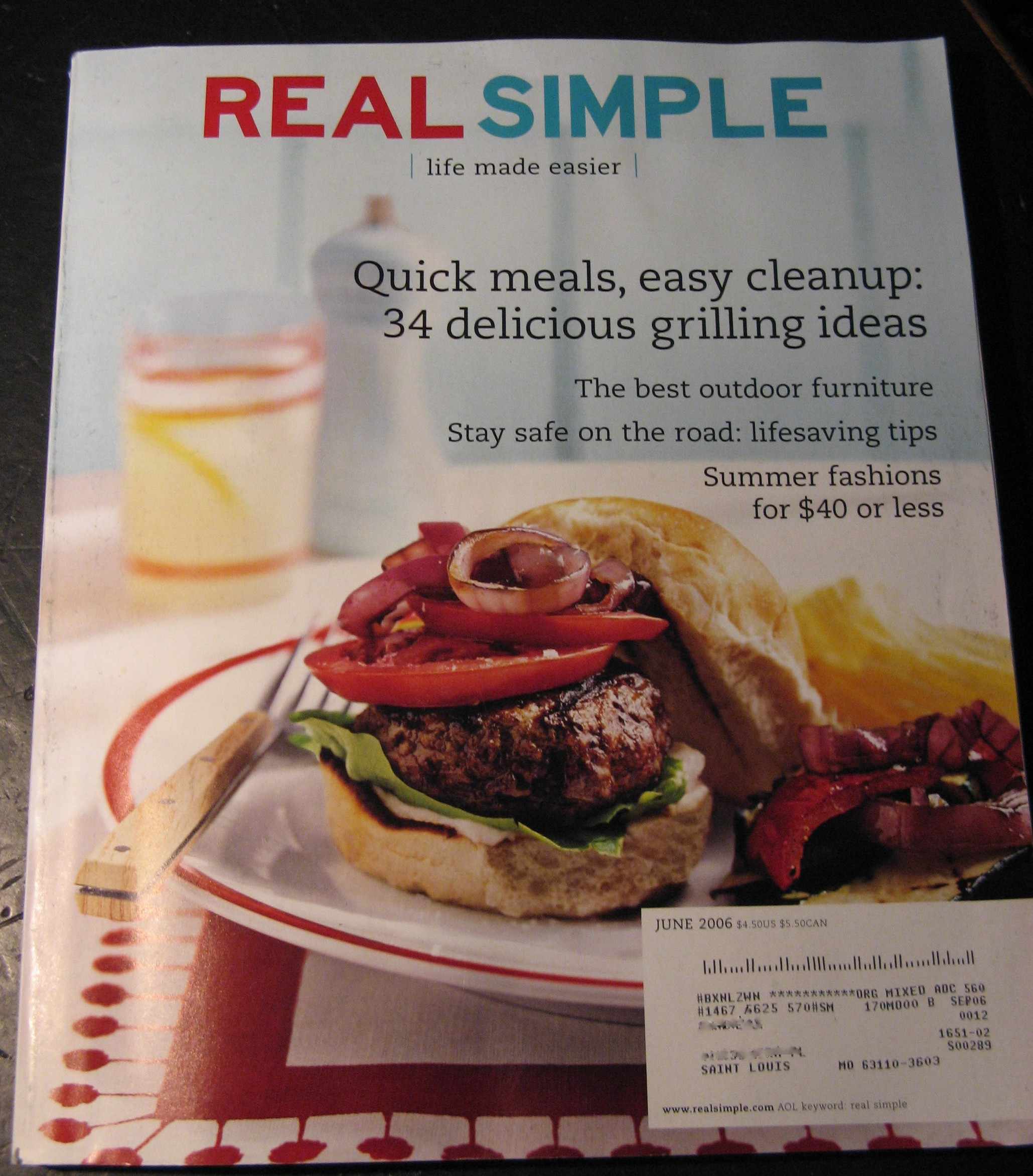
I thought of that old distinction between needs and wants when I recently stumbled across a magazine called Real Simple [2], a magazine displaying the following banner: Life Made Easier.
For the stated purpose of the Real Simple [3], see the About page of the online version:
Founded in 2000, Real Simple magazine continues to be a leader in the category of women’s lifestyle publications. Its concise, useful strategies, coupled with a clean, inspiring design, focus on making busy women’s lives easier, from preparing a fast, healthy breakfast to getting a good night’s sleep. In essence, Real Simple helps its readers do what they need to do, so they have more time to enjoy what they want to do.
When you read the above description carefully, you can see that Real Simple does nothing to discourage us from purchasing wants. Real Simple thus fits perfectly with the runaway consumerist lifestyle that infects the lives of almost every person in this entire country (me included, I admit). In this respect, Real Simple is like almost every other American institution—this includes virtually every organized religion. It is a rare American institution that will intentionally and actively shame Americans into admitting that 95% of the things they own are not needs. Most people don’t want to hear that they buy too much stuff and that they do so to impress others. They’d rather bask in the blindered warmth of owning yet another kitchen gadget, yard toy, garment or knickknack.
Really, can you imagine any American institution (a church, government, charity or club) specifically preaching that there is no need to own a big screen TV? Or that spending money on luxuries like gambling, rare dog breeds or tickets to sporting events is morally suspect on a planet where hundreds of millions of innocent children are starving?
In America, we actively preach the Gospels of must-have to each other. We reassure each other that it is okay to pamper ourselves with fancy food, clothing, jewelry, spa treatments and lavish trips at “nice” hotels. Because we indoctrinate each other so well, we clamor to express our alleged affection for each other by driving to big malls and running up our credit cards at shops geared for impulse buying. There’s a lot of lip service out there: almost all of us claim that we should do away with those things we don’t need. But very few people dare to contemplate seriously that dollars are fungible; that the same dollars for use for luxuries could be used to save lives and relieve suffering. [4] It’s just not American to go around saying it like that. It’s not surprising that we’ve gotten to this point, given that almost all of our information (TV, magazines, radio) gets to us only after passing through the insidious filter of corporate sponsors.
Here’s an illustration of how “simple” now actually means not simple. I have in my hands the June 2006 edition of Real Simple magazine. The two million readers [5] of this edition of Real Simple were bombarded with dozens of advertisements for expensive cosmetics and hair products. The full color ads convey the real gospel of Real Simple. I see vividly colored foldout advertisements for many types of expensive vehicles, such as BMWs and Cadillacs. I see lots of ads for designer clothes, including a DKNY advertisement prefaced by a simple living quote by Anne Morrow Lindbergh. Ads and ads and ads, by Ralph Lauren, Covergirl, Thomasville Furniture. I can see dozens and dozens of gadgets for sale, including a paper towel holder for only $35. I learned that I can grow my own cherry tomatoes, if only I buy a fancy “tomato spiral stake,” buy lots of organic dirt, and buy my seedlings from a nursery.
To keep life truly “real simple,” Real Simple’s ads tell me that I can indulge in that “Sweet Romance Getaway Package” offered by Doubletree Hotels. And why drink water, says yet another full-page ad, when you can drink Coca-Cola Blak, “to awaken your mind and lift your mood.” I’ve learned that another way to simplify my life is to call Prudential Financial to amass more money (presumably to buy more things); this full-page ad features a picture of the mother elephant and baby elephant.
The Wal-Mart double-page fold-out ad invites me to buy Wal-Mart’s “chic dinnerware”-I’ll consider doing that if my current dishes stop working. And, of course, no simple life is complete without those stylish wine racks costing up to $250. In case I get hungry, the full-page cheese ad of The Laughing Cow reminds me that “indulgence has a lighter side.”
If I want to peruse the remainder of this 310-page Magazine, you can do so while sitting on that double full-page Smith and Hawken ad touting the need to have those Adirondack chairs costing only $399 each. I’ll stop there. This review of one edition of Real Simple only gets us half-way through the magazine. If you turn the pages of Real Simple magazine carefully, you might actually find a few articles among the ads. Real Simple is almost entirely a book of commercials, with a cover price of only $4 per issue.
The bottom line, then, is that living “simply” no longer appears to be cheap or easy. Reading Real Simple taught me that I can’t live simply without buying lots of things. And that the more I buy the more simple my life will become. The moral of this story? There truly are a lot of “real simple” things in life. It’s just that the real simple things about life aren’t free.
Print this post [6]
 [7]
[7]