This is a companion piece to “The Magazines of Wal-Mart [1].” In that post (and now in this post) I put on my amateur anthropologist hat and explored the range of reading materials made available to consumers by America’s largest retailer.
I traveled to a Wal-Mart superstore yesteday to check out the types of books for sale. Why? Because Wal-Mart serves as a culture filter to the many people who don’t take the extra effort to shop for books at bona fide book stores. For those people who select their books from the limited offerings of Wal-Mart, here is the full range of written materials with which they are fertilizing their minds. Here is how they prepare their minds to deal with important things such as parenthood, justice, the practices of other cultures, the meaning of life and how to vote.
The book section of the St. Louis area Wal-Mart I visited consists of five large sections of shelves. The three inside sections consist entirely of fiction; most of those titles are romance novels. Here are some of the fiction titles you can buy at Wal-Mart:

Such fiction works constitute 60% of the titles made available by Wal-Mart.
If you are one of those people who wants to buy a “Best Seller,” you would need to check out the first section of book shelves (the left-most). But don’t expect to see any of the following books, each of which is currently ranked within the top 15 books on the New York Times list (these descriptions and rankings are from the NYT list [2]):
- THE GREATEST STORY EVER SOLD, by Frank Rich. A Times columnist attacks the Bush administration’s approach to message management.
- STATE OF EMERGENCY, by Patrick J. Buchanan. The conservative commentator argues against unchecked immigration.
- LETTER TO A CHRISTIAN NATION, by Sam Harris. The author of ”The End of Faith” responds to Christians’ arguments in defense of their beliefs.
- FREAKONOMICS, by Steven D. Levitt and Stephen J. Dubner. A maverick scholar applies economic thinking to everything from sumo wrestlers who cheat to legalized abortion and the falling crime rate. First Chapter
- THE GOD DELUSION, by Richard Dawkins. An Oxford scientist asserts that belief in God is irrational and that religion has done great harm in the world.
- AIR AMERICA: THE PLAYBOOK, by David Bender, Chuck D, Thom Hartmann et al. Essays, transcripts and interviews from ”a bunch of left-wing media types.”
Nor will you find any copies of Static [3], a wonderful new media criticism book by Amy and David Goodman, currently #22 on the NYT list. You can purchase any of these NYT best sellers if you shop at walmart.com, the online version of Wal-Mart. I suppose, though, that Wal-Mart has decided to keep most of the NYT non-fiction best sellers off their store shelves, lest they aggravate their God-fearing shoppers. Or maybe there’s another reason, though I can’t fathom what it might be. Why else wouldn’t you offer to sell nationally recognized best-sellers at your store?
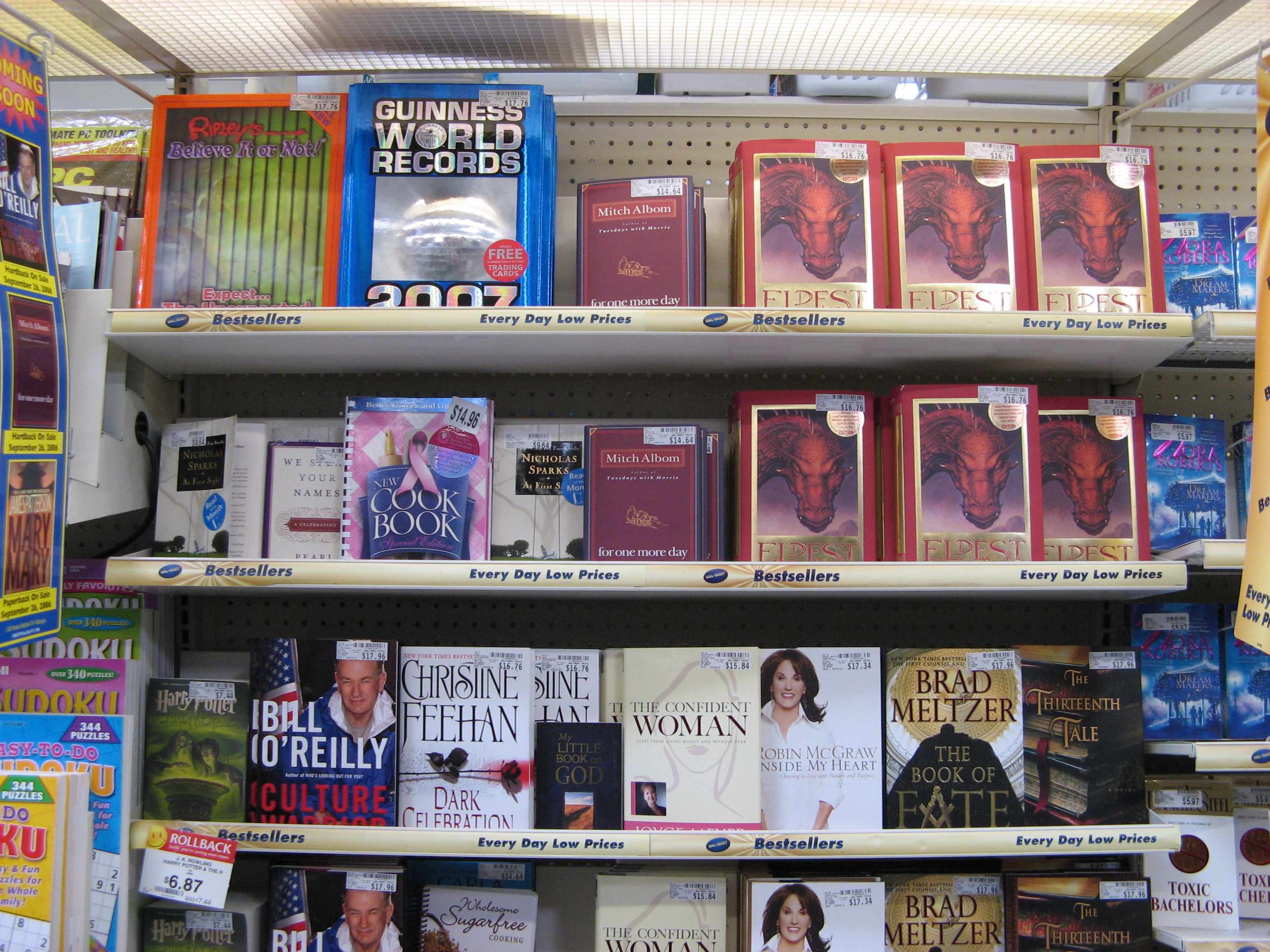
What books would you actually find if you shopped for books in the Wal-Mart “Best Sellers” section? There aren’t actually that many titles offered. Six shelf spaces are occupied by Eldest. What’s Eldest [4]?
The story follows the continued adventures of Eragon and his dragon Saphira, centering around their journey to the realm of the Elves in order to further Eragon’s training as a Dragon Rider.
The way they fill up the shelf space with Eldest, you’d think that there weren’t any other best sellers available.
Two shelf spaces are dedicated to Bill O’Reilly’s new book, Culture Warrior, even though I don’t see O’Reilly’s book on the NYT bestsellers list [5].
Here’s a photo of the bottom of that same “Best Seller” section, books such as 1) Geometry Cliff Notes guide, 2) televangelist Joyce Meyer’s The Confident Woman, 3) the Grey’s Anatomy episode guide and 4) two books on Cardinal baseball. “Best Sellers”? Perhaps, when Wal-Mart refers to “Best Sellers,” it is not referring to the NYT’s best seller’s list. Perhaps Wal-Mart is referring to best sellers based on the people who actually buy at Wal-Mart. Circular logic? Yes. True? Yes, in the same non-evidentiary way we determine most political truths these days.
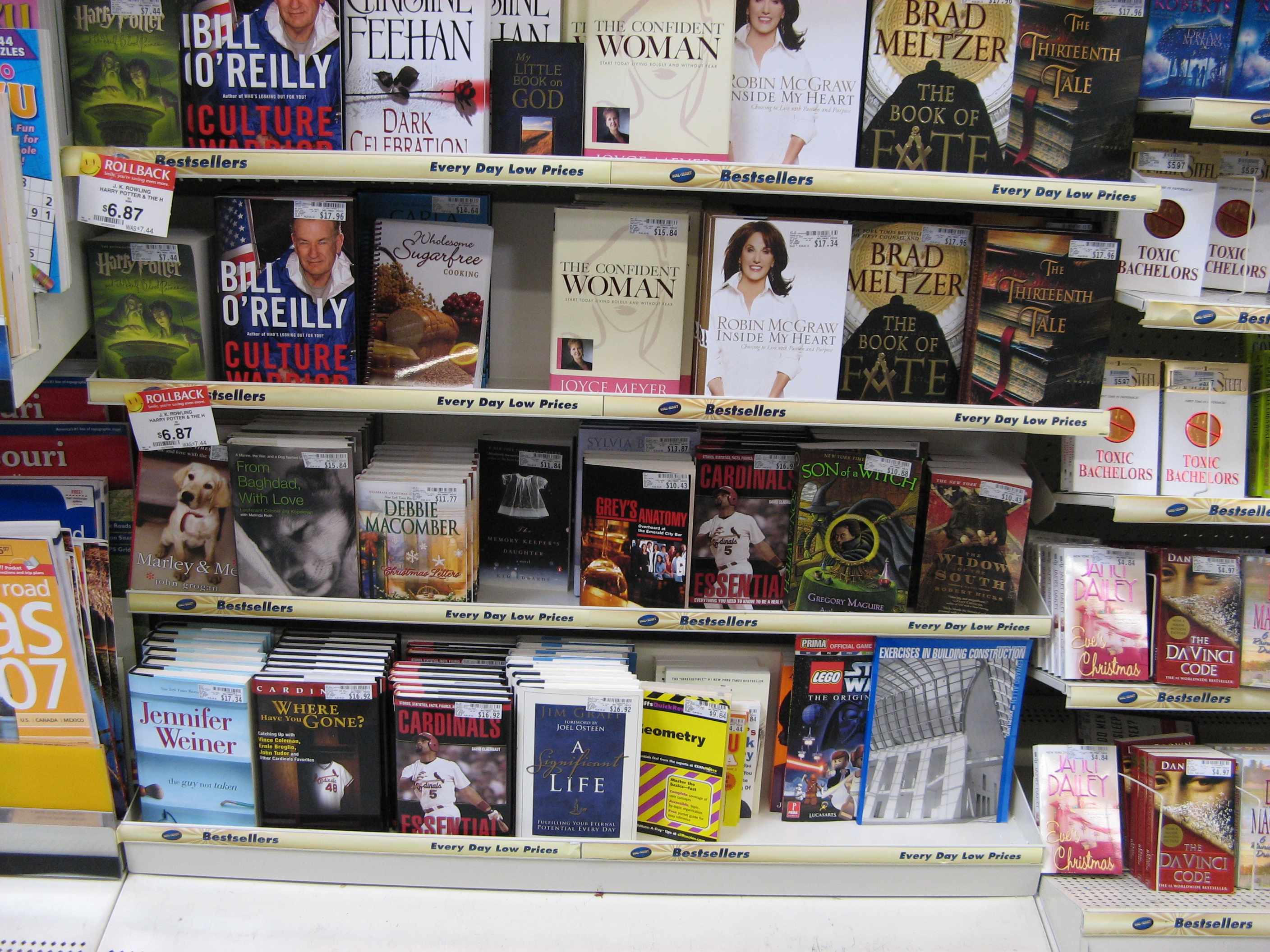
As you can see, there’s not much writing of substance to be found on Wal-Mart’s “Best-Sellers” section. Nor is there much writing that one might consider skeptical or questioning of authority. This makes Wal-Mart the perfect place to shop for books, at least for those who want to continue believing in their current President. Twp exceptions to this non-controversial rule were The DaVinci Code and a couple of Harry Potter books. This proves that money occasionally trumps fundamentalist morality at Wal-Mart.
Moving on to the “Inspirational Center,” (the far right section) you can see that Joel Osteen gets lots of shelf space. This is a nice marriage, of course: Osteen and Wal-Mart. It is hard to imagine any preacher more willing than Osteen [6] to invite you to ignore the poor in order to go shopping for your own impulsive wants. Earthly heaven now and heavenly heaven later, all with a big friendly smile.

If you look to the bottom of Wal-Mart’s “Inspirational Center,” you’ll find eleven types of Bibles or Bible-related books. No copies of the Koran to be seen. Nothing on comparative religion. Nothing to ruffle the sheep.
I also found several copies of “Fundamentals of Building Construction” looking awfully out of place. Or is this a book for inspired architects, I wondered?
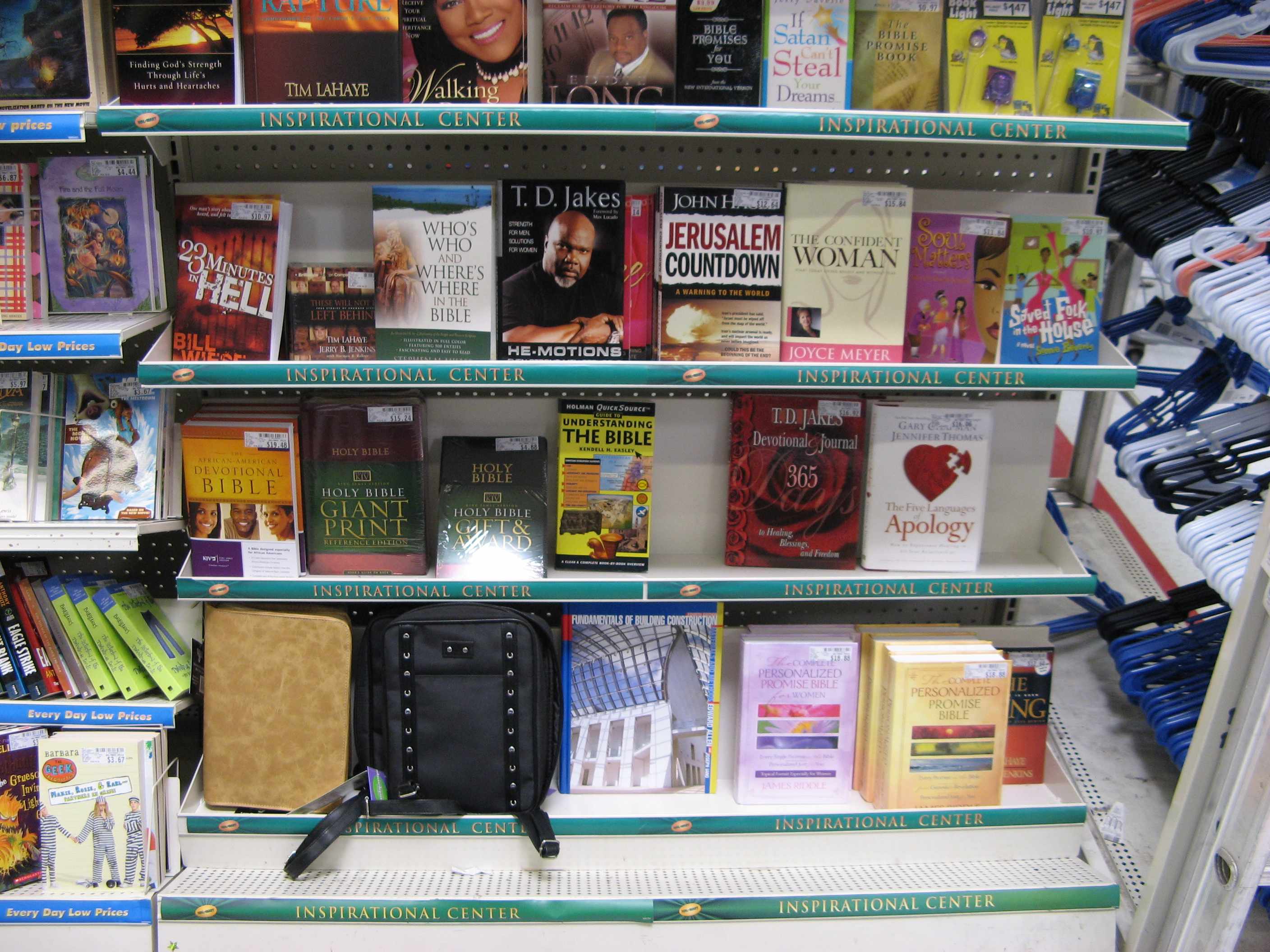
There are other books I haven’t commented upon Specifically, but I’ve provided photos covering each of the titles offered, other than the hundreds of romance novels.
There weren’t any real surprises for me on this anthropological journey. My field trip to Wal-Mart bascially substantiated my suspicions. Here’s the bottom line. If you want to be well-rounded in your book-reading, don’t go to Wal-Mart. What concerns me the most is that many Wal-Mart shoppers probably don’t realize A) the narrowness of the Wal-Mart book selection or B) the importance of testing their long-held assumptions by exposing themselves to challenging new ideas.
Print this post [7]
 [8]
[8]