Last week, at Washington University, I attended a lecture by architect Edward Mazria, who speaks nationally and internationally on the subject of climate change and architecture. Mazria’s organization, Architecture2030 [1] is dedicated to “slowing the growth rate of greenhouse gas emissions and then reversing it over the next ten years.” His proposals are getting lots of attention [2] among architects.
As he states at his website, it is imperative that we deal seriously with CO2. It will
require immediate action and a concerted global effort. As Architecture 2030 has shown, buildings are the major source of demand for energy and materials that produce by-product greenhouse gases. Stabilizing emissions in this sector and then reversing them to acceptable levels is key to keeping global warming to approximately a degree centigrade (°C) above today’s level.
Mazria began his talk with a PowerPoint presentation that largely paralleled Al Gore’s presentation in “An Inconvenient Truth.” Here’s how he sizes things up currently [3]:
Two profound, life changing events are converging to create the most significant crisis of modern time— the warming of the earth’s atmosphere by burning fossil fuels, and the rapid depletion of global petroleum and natural gas reserves. As these events intensify over the coming years, they will dramatically change how we live and how we relate to the natural world.
Here’s how Architecture2030 illustrates the warming of the earth (see the Architecture2030 site [4] for better resolution):
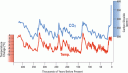
As you can see, CO2 levels (the upper blue line) have never been as high as they are currently. At his lecture, Mazria indicates that humankind’s exhorbitant use of fossil fues constitutes a massive “experiment.”
Here’s how Architecture2030 illustrates the depletion of oil:
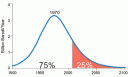
According to Mazria, at current rates we have 42 years of oil and 64 years of natural gas remaining. When we’re done with oil and natural gas, we’ll be much more dependent on much dirtier coal, and clean coal technology is “decades away.” The Architecture2030 site presents the above information in detail.
What’s the solution? Mazria looks to the biggest user of energy. When we combine residences with commercial and institutional structures, buildings consume 48% of our energy, more than any other sector. Combine the energy consumption of buildings with this [5] and it spells opportunity:
In the year 2035, three quarters of the built environment in the U.S. will be either new or renovated. This transformation over the next 30 years represents a historic opportunity for the architecture and building community to reverse the most significant crisis of modern time, climate change.
The energy usage of buildings, combined with society’s need for new and renovated construction lead Mazria to this conclusion: It is time for architects to lead in the race against dangerous climate change. Architects have “great power to solve this huge problem.” But time is not limited. We have only “ten years to turn building architecture around.” Architects should lead the race by engaging in the targets of the “2030 Challenge”:
That all new buildings and developments be designed to use 1/2 the fossil fuel energy they would typically consume (1/2 the country average for that building type).
That at a minimum, an equal amount of existing building area* be renovated annually to use 1/2 the amount of fossil fuel energy they are currently consuming (through design, purchase of renewable energy and/or the application of renewable technologies).
That the fossil fuel reduction standard for all new buildings be increased to:
60% in 2010
70% in 2015
80% in 2020
90% in 2025
Carbon-neutral by 2030 (using no fossil fuel GHG emitting energy to operate).
Is this do-able? Absolutely, according to Mazria. His site contains case studies showing that “building energy consumption reductions of 50% to 80% can readily be achieved through design at little or no additional cost.” How is this achieved?
We know these targets are readily achievable and that most buildings can be designed to use only a small amount of energy at little or no additional cost through proper siting, building form, glass properties and location, material selection and by incorporating natural heating, cooling, ventilation, and day-lighting strategies.
The architects are also ahead of the general public on this issue. While our government sits on its hands, fighting a Middle East war over depleting fuel supplies, private industry is moving ahead. David Suzuki writes that the Average Joe hasn’t a clue [6] about the seriousness or the cause of global warming:
The majority felt that global warming was a very important problem and they were quite concerned about it. But when pressed as to why it was a problem or what caused the problem, all heck broke loose. Apparently, according to the average Joe, global warming is happening because we’ve created a hole in the ozone layer, allowing the sun’s rays to enter the atmosphere and heat up the earth – or something like that. The cause of the problem is cars, or airplanes, or aerosol cans. No one really knows for sure.
Speaking of the Average Joe, there’s still no clue that President Bush has ever considered [7] the critical issues of global warming or the rapid depletion of fossil fuels. This is such a shame. What a difference it could make if our President (and our other leaders) would use the bully pulpit to educate Americans on the dangers of failing to act proactively on these issues.
Here’s some good news: The recommendations Architecture2030 have been adopted by the American Institute of Architecture. Here’s even more good news [8]:
On June 6, the U.S. Council of Mayors voted unanimously to approve a resolution prompted by the AIA position statement that calls for the immediate energy reduction of all new and renovated buildings to halve the national average for that building type, with increased reductions of 10 percent every five years so that all buildings designed by the year 2030 will be carbon neutral—meaning that they will use no fossil fuel energy.
I commend Mazria’s organization for the well-organized information it presents (including its architecture case studies) and for its real world activities that are really making a difference.
Print this post [9]
 [10]
[10]