Check out the map below. It is a map of the Linguistic Geography of the Mainland United States (a higher resolution version is available here [1]):

Imagine that there is some loony person who would argue that the dialect he speaks is the one true, objectively superior dialect and that all other dialects are inferior and actually not true. To dispell that notion, we would merely point out that the dialects tend to dominate geographical regions because people of particular regions tend to learn that dialect from each other as well as passing that dialect on to their children. It’s not because people carefully considered which dialect to speak before speaking.
Now consider one more map:
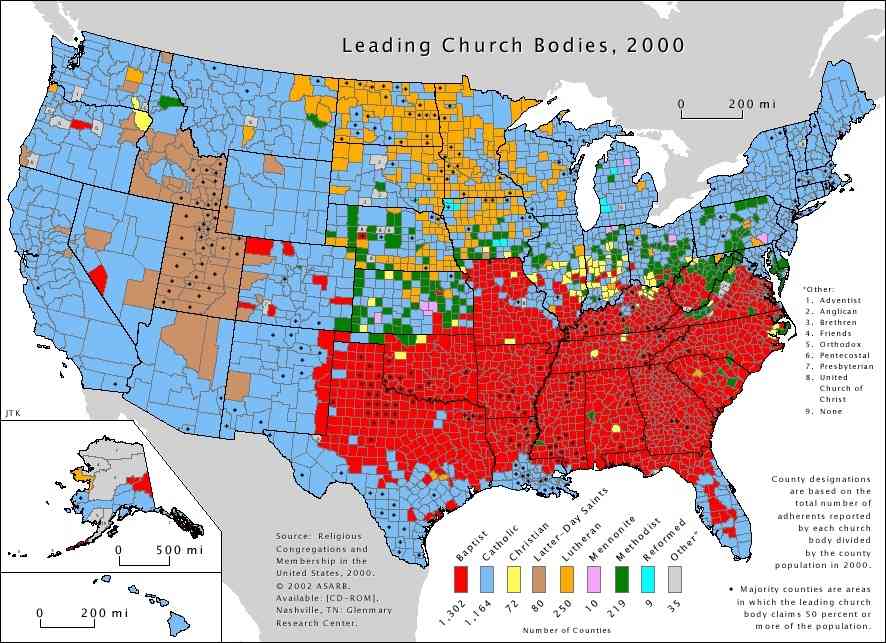
You can find a higher resolution of this map here [2]. This is a map of the predominant types of religions found in various regions of the U.S. As you can see, this map demonstrates that certain religions dominate certain geographic regions (I’m not claiming that religions line up with the dialects, though there are some similarities). Just as with languages, most people don’t usually compare a variety of religions before choosing their own religion (certainly, they don’t do any such shopping while they are children).

If people did tend to choose their religions based on careful comparison shopping, we wouldn’t see particular religions dominating geographic regions. Instead, we’d see a single blended color running from sea to shining sea.
I would conclude that most people (don’t) choose their region’s religion the same way they (don’t) choose their region’s dialect. Instead, they “choose” the one they were taught while they sat on their parents’ laps. This “geography of religions” is something to keep in mind whenever you hear a claim that any particular religion is the one true, holy, apostolic, infallible, objectively correct, ideal, unerring, authentic and undeniably true religion. In these modern times, where ideas travel at the speed of light, the geographic clumping of religions is not consistent with a widespread deliberate choice of religion based upon a perceived superiority of a particular doctrine.
Print this post [3]
 [4]
[4]