I can’t think of a dumber investment policy than to have our states spend three times more on average per prisoner than per pupil… We don’t really have a money problem in America, but a profound values problem and a profound priorities problem.
Marian Wright Edelman, [1] founder and president of the Children’s Defense Fund, during her lecture “Stand Up for Children Now,” on April 19, 2006 at Washington University, St. Louis, Missouri.
Americans spend $60 billion a year to imprison 2.2 million people [2]. This statistic compelled me to pull out my calculator. The result was shocking. In the United States we spend more than $27,000 per prisoner per year. Is this effective? Other than the violence, crowding, beatings by “goon squads,” rapes, riots, and high rates of recidivism, [3] that is, is it effective? There are many reasons to be concerned. Here’s the main reason indicated by the Commission on Safety and Abuse in America’s Prisons [4]:
What happens inside jails and prisons does not stay inside jails and prisons. We must create safe and productive conditions of confinement not only because it is the right thing to do, but because it influences the safety, health, and prosperity of us all.
What might be more effective method of using our limited social resources than putting millions of people in prison? How about investing more in the training and education of disadvantaged children? This is not just an idealistic platitude. In the June 30, 2006 issue of Science (www.sciencemag.org [5] – article available only to subscribers online), James Heckman conducted an analysis that is well worth reading; his article is called “Skill Formation and the Economics of Investing in Disadvantaged Children. Here are some of Heckman’s conclusions:
I. Skill formation is built on foundations that are laid down earlier in life. Therefore, “cognitive, linguistic, social, and emotional competencies are interdependent; all are shaped powerfully by the experiences of the developing child and all contribute to success in the society at large.”
II. Early learning is a foundation for later learning; learning is self reinforcing. Learning skills at earlier ages makes it much more likely that learning will continue. “A child who falls behind may never catch up.” See the following graph (from the Heckman article), which illustrates the fact that, economically speaking, we massively over-invest in later-schooling and post-schooling programs, while we under-invest in providing enriched schooling for disadvantaged children.
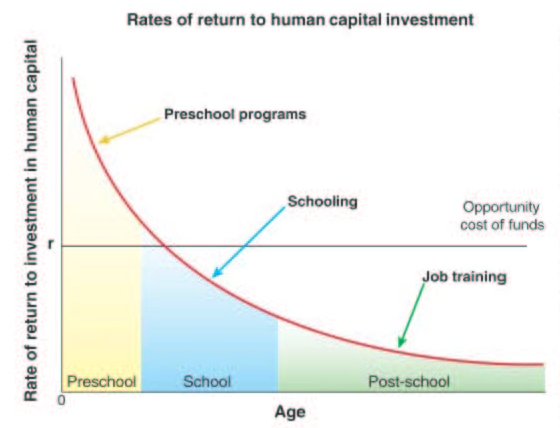
III. Dysfunctional early environments (those that don’t stimulate children) place children “at an early disadvantage.” This has more to do with the lack of stimulation than with the lack of financial resources.
IV. We should not evaluate education programs solely on academic success. Many people argue that Head Start is a failure because it failed to raise the IQ of participants compared to non-participants. According to Heckman, this assessment misses something critical. Even when it does not improve IQ scores, early intervention causes children to be more motivated to learn. Disadvantaged children who had the benefit of early intervention (in the form of enriched preschool environments) “had higher rates of high school graduation, higher salaries, higher percentages of homeownership, lower rates of receipt of well for assistance as adults, fewer out of wedlock births, and fewer arrests.”
V. By third grade, the gaps in test scores become stable. Therefore, intervention later than third grade has little impact improving achievement (compared to intervention prior to the third grade. Typically, the cost of addressing these issues at a time later than third-grade is very expensive in addition to being inefficient. These much more costly programs include reduced pupil-teacher ratios, public job training, convict rehabilitation programs, tuition subsidies or expenditures on police.
Heckman concludes that “investing in disadvantaged young children is a rare public policy initiative that promotes fairness and social justice and at the same time promotes productivity in the economy and in society at large.”
Investing in the education of children is a moral issue. What kind of country would fail to address the early educational needs of its innocent children, thereby dooming many of them to dysfunctional or desperate lives? If that doesn’t grab one’s attention, the following statistic should. Heckman’s study determined that paying to enrich the early educational environment of disadvantaged children pays society economic dividends at a rate of 8.74 to 1. For each dollar spent to enrich the environments of disadvantaged children, society pays 8.74 dollars less for things such as the exorbitant costs of welfare and the criminal justice system.
As of 2003, it cost about $7 billion per year ($7,000 per pupil) to provide Head Start to 900,000 disadvantaged children in the U.S. These children are our future. We hemorrhage an equivalent amount of money every month to occupy Iraq.
Go figure. Literally, go figure.
Print this post [6]
 [7]
[7]