Each of us sometimes feels the pressure of being the lone dissenter in a group. It can make you sweat and it can make your heart pound when you have to go up against the group. How strong is the pressure to conform? This topic was explored and well-documented in the 1950s by Solomon Asch [1], a social psychologist who pitted the human tendency to conform against the tendency to be truthful.
Asch told innocent subjects that they were going to participate in an experiment on visual perception. The subjects were to participate in groups of seven to nine persons per group. The group was instructed to indicate which of the three “comparison” lines were closest in length to a given line. Each person in the group gave his or her answer in turn. There was only one innocent subject per group, however. Everyone else in the group was a stooge who had been instructed to follow a routine prearranged by the experimenter.
The test was actually rather easy and the first three trials were simply a set up for what was going to happen next. On the fourth trial (and, similarly, on selected subsequent trials), where the given line was 1.5 inches long, the three “comparison” lines were .5 inches long, 1.5 inches long and 2 inches long. The experiment had been arranged so that each of the stooges were designated to give his or her answer before the innocent subject had a chance. On that fourth trial, the first stooge answered incorrectly, without any hesitation or indecision. That first stooge indicated that the 1.5 inch given line best matched with the .5 inch long line (not the 1.5 inch “comparison” line).
See the following illustration of a 1.5 inch test line and three “comparison” lines of the lengths described above.
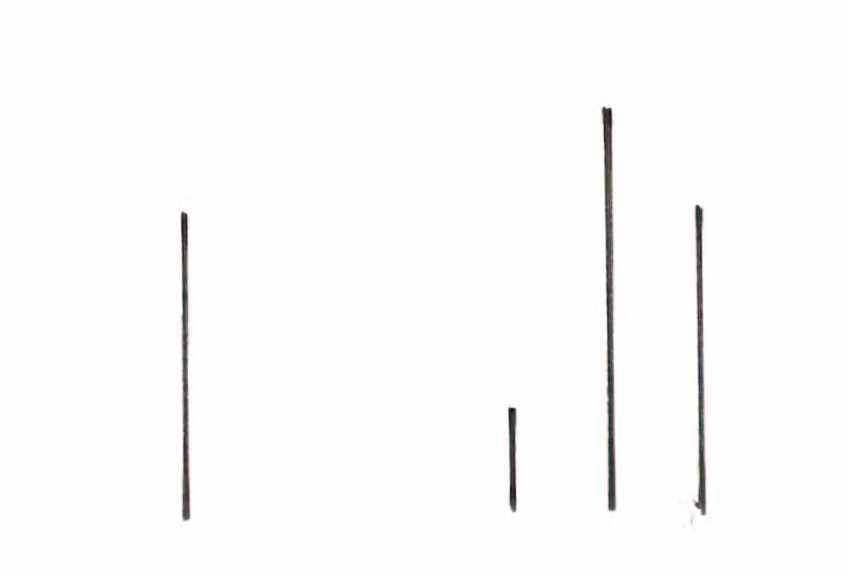
Here is how the events then unfolded, according to Lee Ross and Richard Nisbett in The Person and the Situation: Perspectives of Social Psychology (1991) (a book I highly recommend–all quotes in this post are from this terrific book):
Inevitably, the subjects reaction was one of wide-eyed disbelief, a quick doublecheck to make sure that the judge’s response was as off-base as it seemed, and often a nervous giggle or some other expression of vicarious discomfort at his peer’s folly. These feelings of disbelief and discomfort, however were soon to be greatly heightened and to take on a different quality as the other group members all followed suit and repeated the same wrong answer. At last it was the lone subjects turned to answer and, in so doing, to decide whether to conform to the unanimous majority or to remain independent.
Before running this experiment, Asch expected that most of the subjects would answer correctly despite the numerous wrong answers of all the stooges. The outcome of the experiment, then, was quite a surprise:
Notwithstanding the simple and concrete nature of the perceptual judgment task, subjects typically manifested obvious conflict and discomfort, and not infrequently, they conformed. In fact, anywhere from 50% to 80% of the subjects . . . yielded to the erroneous majority at least once, and overall, conformity occurred on over a third of all critical trials.
Asch found that conformity pressures existed when groups were as small as four. But here’s the really critical thing: if the majority was not unanimous in their erroneous judgments, the pressure to conform dropped dramatically:
when the target subject was provided with a single ally who remained independent, both the percentage of conforming subjects and the frequency with which they conformed dropped precipitously– even when the naïve subject and the ally were confronted with seven or eight judges who all expressed a different [and incorrect] opinion.
Based upon exit interviews, the subjects conformed in spite their own correct perceptions, “either because they believed that their perceptions must be somehow wrong and those of the unanimous majority correct, or because they were unwilling to be a lone dissenter even when they were quite certain that the majority was wrong.”
Asch had locked onto an important principle in social psychology. He had substantiated that individuals would feel pressured to conform to error, especially when asked to stand alone against a group. What’s especially surprising is that the particular task used by Asch was quite easy and the group had no power to reward or punish the subject’s answer. Also surprising was that the correct judgment “appeared so obvious that only fools or mad people could err and they had every reason to assume that the right answer appeared equally obvious to their peers.” Follow-up studies involving math problems, general knowledge items and the social and political judgments also showed that groups without any power to reward or punish dissent “can exert potent conformity pressures.”
In sum, people “find dissenting difficult when they have no comrades who will do likewise.”
I often think of these studies by Asch on those occasions when I am put in the position of being the lone dissenter in a large public group. In those situations, speaking up and stating the obviously correct answer can feel uncomfortable. In fact, for some of us, the correct answer can actually feel incorrect. There is often a risk, then, that consensus can be built as a result of social dynamics rather than by reference to clear and determinative evidence.
There are some obvious applications to the lessons taught by Asch. For instance, it is important to have media outlets and political forums that will allow–even invite–dissent. Sometimes, everyone remains silent even though the king obviously has no clothes. And sometimes, the courage of the first dissenter breaks a psychological dam that is holding back great rivers of dissent.
Print this post [2]
 [3]
[3]