Peter Singer discusses robots and the future of war

At this TED talk, Peter Singer explains how robots are increasingly replacing soldiers, but they are turning war into entertainment akin to video games, encouraging "war porn" videos, creating "cubicle warriors," and painting us as cold-hearted aggressors to the rest of the world. And it's about to get a lot worse, when armed autonomous systems come online. Singer argues that many ethics issues are lagging far behind the dangers of widely implementing these robot technologies. He also suggests that the problem is not in the machines themselves, but in the fact that we appear to be "wired for war."

Continue ReadingPeter Singer discusses robots and the future of war

I want to work with Thomas Heatherwick

I have worked with architects, engineers and contractors for nearly 20 years, managing the design and construction of all manner of facilities. As more than 18 of those years were in the public sector (15+ federal - military, 3+ municipal), function over form was unfortunately a primary design consideration. Where form did come into play, it was usually a more decorative stone face instead of some brick. Too often, I was working with budgets set down four to five or more years earlier, and in some cases with unchangeable scopes of work - the military construction (MILCON) program is rather rigid in that respect to ensure what is authorized is built (getting permission and funding for one thing but building another is verbotten). You can imagine that the crystal ball gets a little foggy out that far. And, by the time you get the funding to design and build, the budgets are usually too little to do what is needed, requiring creative scope cutting to get the most product for the buck. And that is why almost no federal, and very few municipal buildings are anything other than sterile designs that serve a functional and nearly never a visual need. So you can probably see why architect Thomas Heatherwick, and his firm Heatherwick Studio are such a treat for me. His designs are visually stunning, incredibly creative and are slap-the-forehead wake-ups to what we should be able to do at no more cost than traditional design. I was amazed at the very innovative solution to a common construction requirement (no spoiler...it's at the 4 minute point in the video), and even more amazed at the focus of his talk: the British contribution to the 2010 Shanghai Expo, the Seed Cathedral. Imagine deliberately designing a building with 60,000 penetrations...and then making it work.

Continue ReadingI want to work with Thomas Heatherwick

Open source knowledge…what a novel concept

Thirty years ago, give or take, I read Lucifer's Hammer (by Larry Niven and Jerry Pournelle) for the first time. Published in 1977, it has a few dated elements, but apart from those, it holds its own in my mind. The novel describes a near future after a comet hits the Earth. I enjoyed it, but one very small reference stcuk in my head. One of the characters has a library (that he preserves from the anarchy) and the one book he takes as currency to the outpost central to the novel is "Volume Two of The Way Things Work." Google "The Way Things Work" now, and you'll likely find mostly hits on David Macaulay's illustrated book. Nice...and informative, but not the one Niven and Pournelle were talking about. I searched for years, pre-internet, before finding my copy. It's an eighth edition of the one originally published in 1963 by Simon and Schuster; subtitled "An Illustrated Encyclopedia of Technology." It's a single volume, not two, and although also dated (vacuum tubes), it is still an enormous, condensed wealth of knowledge. I'm not an end-of-the-world type person, but I have several survival books of this nature (Back to Basics, The American Boys' Handybook, etc.) for my children and descendants...just in case. Not in case of the end of the world, but in case they get stranded or what have you. Driving around to look in on various construction projects today, I listened to a few TED videos and one, very short by TED 18 minute standards, conveyed in four minutes one of the more amazing ideas I've seen at TED, host of hundreds of amazing ideas. Marcin Jakubowski, a Polish American with a PhD in fusion physics, founded Open Source Ecology, "home of the Global Village Construction Set, developing community-based solutions for re-inventing local production" after starting a farm. I'll let him describe what he's done: I'm adding this to my various "Way Things Work" works. It's free, brilliant, full of maker ideals, and can deliver affordable technology to the world. Maybe I'll even be able to contribute.

Continue ReadingOpen source knowledge…what a novel concept

Impossible physics

As I approach my 50th birthday, I’ve been having fun coming up with various lists of 50 things – 50 people I want to meet, 50 sitcoms I’ve watched at some time in my lifetime, 50 quotes I like, etc. Among the lists of lists, I gen’d up two of books I want to read (50 is far too small a number for either list, but it fits with the age thing): 50 books I own that I have yet to read - I have many, many more than that, and 50 books that I do not own that I want to read. Of course, if I ever read any of them, I will likely find myself adding to my library (no surprise there). Physics of the Impossible by Michio Kaku happened to be first on my list of books that I do not own that I wanted to read. I picked it up last Monday when returning A Confederacy of Dunces to the library. I hadn’t planned on getting it – I was only looking to see if it was in – but was taken in immediately by the subtitle: “A Scientific Exploration into the World of Phasers, Force Fields, Teleportation, and Time Travel”. Not unlike Star Trek – I’m Working On That by William Shatner and Chip Walter, the book promised a survey of science fiction concepts becoming a reality, but very unlike Shatner’s book, here was a theoretical physicist doing the looking and explaining why something could not be done or how it might. It’s a rare scientist (or engineer for that matter) who is truly respected by his/her peers for research results/theories who can also communicate to the masses. Richard Dawkins certainly made that leap (his early books are more academic than his later works). When it comes to physicists, I think the pool shrinks. Stephen Hawking did a marvelous job conveying cosmological concepts in his books, as did Brian Greene – though Green’s books, while quite readable, are still fairly technical for the average person. Michio Kaku writes a very readable book…for a physicist who is the co-founder of string field theory. Perhaps that is an unfair qualification. I have known many physicists who are wonderful conversationalists, but I don’t know if they are so because I am interested in their subjects or that they are simply wonderful conversationalists with everyone. Regardless, Kaku writes as one of those wonders. Peppered throughout this book are references to other books (a lot of fiction), a few movies, some history of the people and science behind the science. Those may make Kaku more accessible to the average reader, but I think it just shows that he has a life outside of theoretical physics. In Physics of the Impossible, Kaku looks at science fiction to see what might possibly become science fact. He breaks down his subjects into three classes of impossibilities:

  1. Technologies that are impossible today, but do not violate known laws of physics and may be possible in some form in this or the next century (these are force fields, phasers, Death Stars, ETs and UFOs, teleportation, starships/antimatter engines, antimatter universes and certain forms of telepathy, psychokinesis and invisibility.)
  2. Technologies that “sit at the very edge of our understanding of the physical world.” They may not be possible at all, and if so, will likely only be possible thousands or millions of years in the future (these are time machines, hyperspace and wormhole travel as forms of travel faster than light, and parallel universes.)
  3. Technologies that violate the known laws of physics, which if possible, will result in a fundamental shifting of understanding of physics (Kaku notes there are surprisingly few such impossibilities, examining only perpetual motion machines and precognition).
Of course, one should read the book before thinking that Star Trek’s transporters, phasers, warp engines, or shields (force fields) could ever become a reality. I won’t spoil your read by revealing what the “certain forms” might be, but you can guess that Dr. McCoy won’t be complaining about having his atoms scattered across the universe for many centuries to come. I was intrigued by Kaku’s discussions of what one would call paranormal, but after he gently observes that there has never been any real evidence for telepathy, psychokinesis or precognition, he explains the physics behind how one might be able to realize a part of the first two (precognition violates the known laws of the universe, thus cannot be performed through any technology...but is not completely impossible.) I liked his summary of science and psychokinesis:
One problem with analyzing psychokinesis scientifically is that scientists are easily fooled by those claiming to have psychic power. Scientists are trained to believe what they see in the lab. Magicians claiming psychic powers, however, are trained to deceive others by fooling their visual senses.
He’s fair where research has had some seemingly positive findings, but does note that “fully half” of the successful trial of the Princeton Engineering Anomalies Research Program “originated from a single individual” and that the results are always non-reproducible. The lesson here is that while almost nothing is impossible (what scientists really mean is that these ideas are impossible for primitives such as us), the technology needed to overcome the impossible is impossibly advanced. So, I strike one from one list and add at least seven, as I now want to read Kaku’s other books. I highly recommend Physics of the Impossible as a diversion from the contemporary news.

Continue ReadingImpossible physics

Robots and human interaction

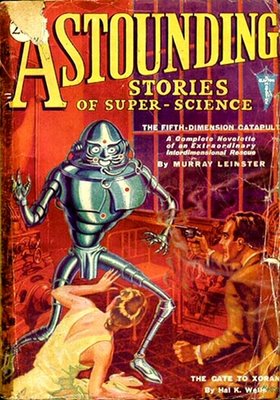
Last year, before I even heard of DI, I resolved to read all 15 of Isaac Asimov’s books/novels set within his Foundation universe this year. Why “before I even heard of DI”? Well, you may already know, but I won’t spoil the detective work if you don’t. (Hint: scroll down to the list about ¾ down the wiki page.) Why “this year”? I spent the summer and fall studying for an exam I had put off long enough and had little time for any outside reading. I read I, Robot nearly 40 years ago, and The Rest of the Robots some time after that, followed by the Foundation trilogy, Foundation’s Edge when it was published in 1982, and Prelude to Foundation when it was published in 1988. I never read any of the Galactic Empire novels or the rest of the Foundation canon, and none of the “Robot novels”, which is why I decided to read them all, as Asimov laid out the timeline. I do like to re-read books, but hadn’t ever re-read any of the robot short stories, even when I added The Complete Robot to my collection in the early 1980s. As I’ve slept a bit since the first read, I forgot much, particularly how Asimov imagined people in the future might view robots. Many recognize Asimov as one of the grandmasters of robot science fiction, (any geek knows the Three Laws of Robotics; in fact Asimov is credited with coining the word “robotics”). He wrote many of his short stories in the 1940s when robots were only fiction. I promise not to go into the plots, but without spoiling anything, I want to touch on a recurrent theme throughout Asimov’s short stories (and at least his first novel…I haven’t read the others yet): a pervasive fear and distrust of robots by the people of Earth. Humankind’s adventurous element - those that colonized other planets - were not hampered so, but the mother planet’s population had an irrational Frankenstein complex (named by the author, but for reasons unknown to most of the characters being that it is an ancient story in their timelines). Afraid that the machines would take jobs, harm people (despite the three laws), be responsible for the moral decline of society, robots were accepted and appreciated by few (on Earth that is.) {note: the photo is the robot Maria from Fritz Lang's "Metropolis", now in the public domain.} Robots in the 1940s and 1950s pulp fiction and sci-fi films were generally menacing like Gort in the 1951 classic, The Day the Earth Stood Still, reinforcing that Frankenstein complex that Asimov explored. Or functional like one of the most famous robots in science fiction, Robbie in The Forbidden Planet, or “Robot” in Lost in Space who always seemed to be warning Will Robinson of "Danger!" When writing this, I remembered Silent Running, a 1972 film with an environmental message and Huey, Dewey and Louie, small, endearing robots with simple missions, not too unlike Wall-E. Yes, robots were bad again in The Terminator, but we can probably point to 1977 as the point at which robots forever took on both a new enduring persona and a new nickname – droids. {1931 Astounding was published without copyright} Why the sketchy history lesson (here's another, and a BBC very selective "exploration of the evolution of robots in science fiction")? It was Star Wars that inspired Dr. Cynthia Breazel, author of Designing Sociable Robots, as a ten year old girl to later develop interactive robots at MIT. Her TED Talk at December 2010’s TEDWomen shows some of the incredible work she has done, and some of the amazing findings on how humans interact. Very interesting that people trusted the robots more than the alternative resources provided in Dr. Breazel’s experiments. Asimov died in 1992, so he did get to see true robotics become a reality. IBM’s Watson recently demonstrated its considerable ability to understand and interact with humans and is now moving on to the Columbia University Medical Center and the University of Maryland School of Medicine to work with diagnosing and patient interaction. Imagine the possibilities…with Watson, and Dr. Breazel’s and others’ advances in robotics, I think Asimov would be quite pleased that his fears of human robo-phobia were without … I can’t resist…Foundation.

Continue ReadingRobots and human interaction