Sheep Handling During Covid

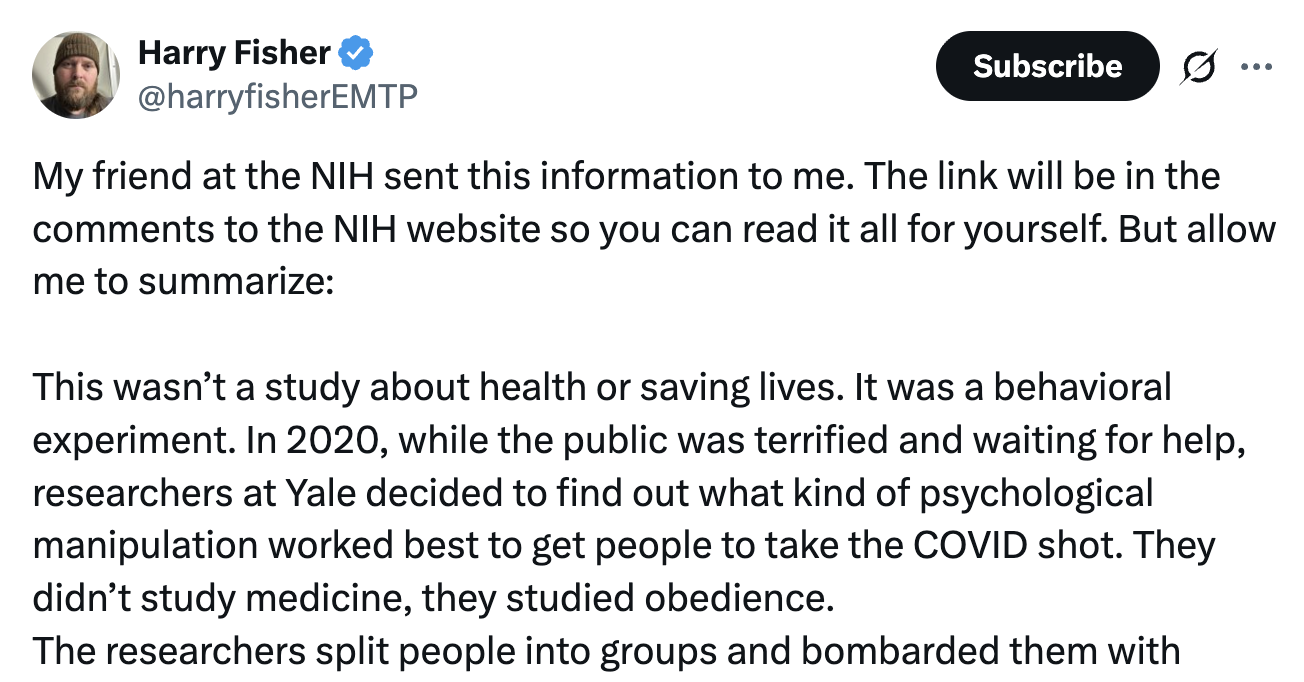
Post by Harry Fisher, reporting on a 2020 Yale Study. Excerpt:

[R]esearchers at Yale decided to find out what kind of psychological manipulation worked best to get people to take the COVID shot. They didn’t study medicine, they studied obedience.

[R]esearchers at Yale decided to find out what kind of psychological manipulation worked best to get people to take the COVID shot. They didn’t study medicine, they studied obedience.

The researchers split people into groups and bombarded them with different emotional triggers. One message told people to think of vaccination as a “moral duty to protect others.” Another said that refusing the shot wasn’t brave but “reckless.” Others used guilt and shame, “How would you feel if you got someone sick?” or “Imagine how embarrassed you’ll be if you spread the virus because you refused.”

Then they measured which message made people cave fastest. Which one made them not only say, “Yes, I’ll get the vaccine,” but also, “I’ll pressure my friends to do it too.”

The results were exactly what you’d expect, the messages that made people feel guilty, ashamed, or afraid of being judged were the most “successful.” The study admits that those messages stirred people to persuade others and to judge anyone who declined as ignorant or selfish. In other words, they found the recipe for social coercion, and called it “science.”

This research wasn’t about understanding, it was about control. It created the tone that dominated those years, the moral superiority of the compliant and the public humiliation of the skeptical. What we lived through wasn’t spontaneous mass hysteria. It was engineered with precision, it was tested, measured, and rolled out.

We were never “informed.” We were handled.

Continue ReadingSheep Handling During Covid

Stark Sex Differences Re Intolerance of Opposing Viewpoints

Fascinating research from "The Eternally Radical Idea." Worth reading Chapin Lenthall-Cleary's entire article here.

Amazingly, it turns out that men are often more tolerant of the opposite side than women are of their own side.

The data comes from FIRE’s annual College Free Speech Rankings, which is designed to gauge the state of free speech on American college campuses as well as student attitudes toward free speech. This includes gauging students’ feelings towards allowing various hypothetical speakers on campus, which we can break down by various characteristics. When evaluating the data based on gender, some shocking trends arise.

Men are, on average, significantly more tolerant and less censorious than women. By contrast, while political affiliation makes people more biased towards speakers on their side, it affects their overall willingness to let speakers speak, regardless of ideology, very little. However, regardless of party or ideology, men are significantly more tolerant than women, so much so that the gender difference dominates the ideology difference. This effect is even more acute in the extremes: men are over 3.5 times more likely than women to be “perfectly tolerant” of opposing views — meaning they would definitely allow any campus speakers, including those they disagree with.

Further,

And while left-wing women are stereotypically seen as being uniquely censorial, the reality is that this tendency applies to all groups of women, regardless of ideology.

And this:

Democrat-leaning independents are more tolerant of both sides than Democrats, and Republican-leaning independents are more tolerant of both sides than Republicans. Again, however, we see the stark effects of gender on these measurements: male Democrats are more tolerant of right-wing speakers than female Republicans.

And this:

Many women display extreme censorial attitudes, and only towards right-wing speakers.

What is causing this? 

My suspicion, corroborated by other research, is that women have much stronger general opposition to speech that may cause emotional discomfort and a preference for harmoniousness.

One of the above sources was a 2021 Psychology Today Article. Here an excerpt:

  • In a 2019 study, 59% of women said protecting free speech was less important than promoting an inclusive society, while 71% of men felt opposite.
  • Two recent studies of online adults revealed that women were more censorious than men.

Continue ReadingStark Sex Differences Re Intolerance of Opposing Viewpoints

Mike Benz Describes the Challenges of Dismantling Joe Biden’s Censorship-Industrial Complex

Because they cling to corporate media as their main source of “the news,” many of the most vocal people online don’t realize that the Biden Administration poured billions of tax dollars into censoring and propagandizing Americans. Nor do they know the details. This secret operation was so vast and so ghastly that the Fifth Circuit Court of Appeals concluded:

[T]he Supreme Court has rarely been faced with a coordinated campaign of this magnitude orchestrated by federal officials that jeopardized a fundamental aspect of American life. Therefore, the district court was correct in its assessment—“unrelenting pressure” from certain government officials likely “had the intended result of suppressing millions of protected free speech postings by American citizens.” We see no error or abuse of discretion in that finding.

Who were the recipients of this tax money? Answer: Numerous government agencies, including DHS and USAID (and many others), who funneled the money out to dozens and dozens of NGO and non-profits with disarmingly patriotic names (e.g., Global Engagement Center and the National Science Foundation) who did the dirty work, often in close coordination with prestigious American universities. They worked in tandem with each other and with the CIA, which continued to make good use of all of its favorite Project Mockingbird techniques to convince you to be someone else. Many of the doubters don’t know CIA history. They don’t know that the CIA has topple dozens of governments Or they assume that the CIA used to be bad but they somehow got to be the good guys when after they displayed animus against Trump.

This censorship-industrial complex (also sometimes referred to as “the Blob”) has convinced you that you were well-informed and that you were thinking your own thoughts. They made sure you only heard one version of every story so that you voted only for the “correct” candidate. They were so good at their jobs that you believed that virus particles couldn’t pour through cloth masks. They made sure that you slurped up every government-approved position and that you deep-down hated those who disagreed with you, including your friends and family members.

[More below, including the transcript of Mike Benz' entire talk at NatCon

Continue ReadingMike Benz Describes the Challenges of Dismantling Joe Biden’s Censorship-Industrial Complex

Jokes and Fragility

Ricky Gervais:

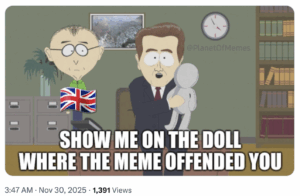
How arrogant are you to think that you deserve to go through life with no one ever saying anything that you don't agree with or like? I want people to stop saying "That joke's offensive." I want them to start saying "I found it offensive" because you've got to own your emotion, because that's all it is. You're just telling me how you feel about it. Yeah, there's nothing intrinsically offensive about this joke. We shouldn't hurt people's feelings. Well, you can if their feelings are wrong, If you don't like the facts, don't change the facts. Change the feelings.

Continue ReadingJokes and Fragility

Long Winded Conversations by the numbers

All of us have been in some intolerable conversations with long-winded people. Some people don't know how to give and take. In my mind, good conversation is like a game of catch. Lots of people don't know how to get to the point and then let others talk.

I asked Grok for the research on this. How long can a person talk in a small group before others feel left out and get frustrated?

Grok's response:

Research on conversation dynamics, particularly in small groups (typically 2-5 people), highlights the importance of equitable turn-taking for maintaining engagement and satisfaction. Studies in linguistics and psychology show that natural conversations rely on rapid exchanges, with average utterance lengths around 2-4 seconds per speaker in dyads (one-on-one) and slightly longer in triads (three people), at about 2.7 seconds and 3.7 seconds respectively.

These short turns, separated by minimal gaps of about 200 milliseconds, create a rhythmic flow that allows everyone to contribute without feeling sidelined. When one person extends their turn significantly—holding the "floor" for much longer—it disrupts this balance, leading to perceptions of dominance.Conversational dominance occurs when a single speaker monopolizes airtime, often through extended monologues or repeated interruptions, and research links it directly to frustration among listeners.

For instance, nonverbal cues like prolonged speaking time and higher vocal energy signal dominance, which group members perceive subconsciously; in meeting simulations, dominant speakers were accurately identified 85-91% of the time based on such cues alone. This imbalance can make quieter participants feel excluded, prompting them to withdraw entirely—creating tension where others remain silent to avoid conflict. In extreme cases, it drives group members away, turning potentially enjoyable interactions into ones people dread.

Psychological studies quantify the emotional toll: A survey by the American Psychological Association found that 60% of people feel anxious and overwhelmed during encounters with long-winded speakers, viewing it as a subtle form of social control that heightens stress. Similarly, research from the University of California, Berkeley, showed that one-sided conversations reduce relationship enjoyment by 50%, eroding trust and overall satisfaction.

Over-talkers often prioritize personal anecdotes over group themes, leading to redundancy and boredom, which further alienates listeners by breaking the expected "just enough information" rhythm. While no study pinpoints an exact universal threshold (as it varies by group familiarity, culture, and context), frustration typically emerges when a speaker's turn exceeds 10-20 seconds or when they claim more than 30-40% of total airtime in a discussion—far beyond the 2-3 second norm.

In small groups, this dominance is amplified because cognitive limits (e.g., mentalizing multiple perspectives) cap effective conversations at around 4 people; larger imbalances exacerbate feelings of being left out. Strategies from communication research, like gentle interruptions or thematic redirection, can mitigate this, but the core issue is restoring reciprocity to keep everyone engaged.

Continue ReadingLong Winded Conversations by the numbers