
I’m not trying to rain on anyone’s parade, or should I say, snow on anyone’s parade. The Christmas season can be a terrific opportunity to hear extraordinary music and to catch up with the people we care about. But there is something I’d like to discuss that perplexes me, especially at this time of the year.
Those who read this blog know that I am a skeptic and that I don’t believe that a divine man named Jesus saved the world. Nor do I think most people who say they believe these things actually believe them, based upon the fact that most people who say they believe in the divinity of Jesus spend very little time learning about the origin of the Bible. Almost none of them take the time to learn Hebrew or Greek, the language used by the earliest manuscripts of writings
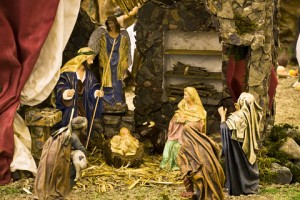
that they claim to be the direct word of God. Almost none of them pride themselves on being highly informed about the content of what they claim to be the most important book in the world. In short, the behavior of most Believers suggests that they don’t deeply believe the things they say they believe about the alleged existence and importance of the man they call Jesus.
I don’t want to sound too harsh, because this is the Christmas season, and I am well aware that numerous people find inspiration in their religious beliefs and they are motivated by those beliefs to do impressive acts of kindness.
Nonetheless, I am on the outside looking in with regard to Christian religious beliefs. From my viewpoint, it is difficult to understand how anyone could claim to believe that a man who was actually God was born at all. One reason I have such trouble is that I don’t see the Christmas story as a single belief. Rather, I see “it” as a nested hierarchy of highly improbable events. In order to believe the Christmas story, one must actually believe a long series of events that depend upon each other in order for the entire story to be true.
Let’s start at the beginning. Did the universe always exist (perhaps as a pulsing series of big bangs or as a huge mostly invisible network of multi-dimensional strings that occasionally bud in the form of individual universi)? Or was there a first clause of the universe, a prime mover? I find the first option to be much more likely, but I’ll admit that it’s possible that there could have been a first cause, some sort of entity that created the universe such that before the creation, there was no universe at all. What are the odds that there was some sort of entity that created the universe? I would think it highly unlikely, about as unlikely as the Norse claim that four dwarves held up Ymir’s skull to create the heavens, or any of the creation myths of any of the other religions of the world. Nonetheless, let’s assume that it’s 60% likely that the universe had a first cause.
We’re still a long way from locking down the entire Christmas story. The next step is considering the likelihood that the creator of the universe is sentient (conscious), as opposed to the insentient “God” of Einstein. It’s highly speculative to put any sort of likelihood on this possibility of sentience. Let’s assume, nonetheless, that it is 60% likely (and 40% unlikely) that “God” is sentient. Then let’s go to the next step.
What is the likelihood that this sentient creator of the universe resembles the God described by the Old Testament? After all, there are many other religions that describe their universe-creating gods in different ways. What is the likelihood that there is a creator of the universe who is sentient and has a personality similar to that described in the Old Testament? Let’s assume it’s 60% likely. Now let’s move to the next step.
What is the likelihood that this Old Testament God actually created Adam and Eve, then banished them from Paradise in the state of sin, making it necessary for a savior to fix things later on? Let’s assume that this is 60% likely and move to the next step.
What is the likelihood that this universe-creating sentient God impregnated a woman thereby creating a human form of himself called “Jesus.” I find it very difficult to believe. Nonetheless, let’s assume it is 60% likely that Jesus was divine and that he was his own father.
The next improbable event is the claim that Jesus died on the cross, then rose from the dead, thereby saving people from their sins? Let’s assume that this is 60% likely to have occurred.
I could have assembled a much longer string of probabilities, each of them depending upon the truth of the preceding alleged event(s), but this much should give you the idea. The likelihood of an event happening when it relies upon a prior event can be determined by multiplying the two likelihoods. If it is 60% likely that it will rain this weekend and it is 60% likely that when it rains my roof will leak, then there is a .60 x .60 = 36% chance that my roof will leak this weekend.
Using this approach, let’s consider the likelihood that Jesus saved us from our sins. In order to believe that Jesus saved me from my sins based on the traditional Christian account of this, I must also believe each one of a long string of difficult-to-believe claims, including the claims I’ve listed above. We calculate the likelihood of the entire story being correct by multiplying .60 by itself five times. The resulting likelihood that Jesus was exactly who Christians claim he was is about 5% likely. This low likelihood is what we should expect from common sense. Even if each rung of a ladder is only a little wobbly, the whole ladder will nonetheless be dangerously wobbly. If we are only 5% sure of each of these steps being true, the likelihood of the entire Christian story being true is 0%.
Despite the result of the math, this remains the time of year when many people proudly and confidently belt out numerous songs proclaiming that God created the universe, Jesus was born, Jesus was God, and Jesus saved us from our sins. They sing these claims without any doubt at all, even though these are extraordinary claims that lack extraordinary proof, and even though the religious claims being sung at this time of year rely upon a long inter-related series of fantastic claims. It is as though this interrelated set of claims depends upon a mental ratcheting effect. As long as someone barely believes any of the earlier and more basic claims, by the time they move on to the next claim (which depend upon the earlier claim(s)), the earlier claims have become unquestionable gospel, having clicked into place by the mere fact that someone relied upon them in order to substantiate later claims.
A long string of highly questionable assertions cannot possibly make anything other than a wobbly house of cards, even if one assumes that each of the assertions is more likely than not true. But that’s not how religious claims work in the real world. People who sing loudly that Jesus has saved us are not inclined to ever revisit the low-level assumptions upon which they base their conclusion that Jesus has saved us. Perhaps this is to be expected, given the limited attentional capacities of humans, given that humans are so prone to mental fatigue, given the precariousness of the human condition and given that emotions are the masters of the human intellect. Further, even though religious believers often claimed to be certain that they are correct, there not necessarily any relationship between being certain and being correct.
Again, I’m not writing this post to disparage those who honor Christmas season (even though I’m cynical regarding the hyper-materialist aspects of the season). Rather, I’m offering an outsider’s perspective on what I find to be an extraordinary multi-faceted claim that a little baby in a manger actually grew up and saved us from original sin that had been inflicted upon us when our ancestors disobeyed a direct order from a sentient God who created the universe out of nothing at all.
Please do feel free to belt out Christmas songs proclaiming, with certainty, that all of these things occurred. If I’m in your company, though, it’s likely that I won’t be buying your melodic claims, even though I might be enjoying the the music.


Erich,
I certainly agree with your point that many people celebrate Christmas traditions that do not have much reference to their beliefs that Jesus was God and was born into humanity in a barn a couple thousand years ago. It is quite a stretch to connect those beliefs in Jesus to the trees, toys, some of the songs, and Santas that are the focus of this time of year for many in America whether or not they profess some degree of Christian faith.
I also agree that believers would do well to consider the extraordinary claim that their faith makes in the story of Jesus as God who became man and was sent to earth to live and die for humanity's sake. In and of itself, and in light of the implications you lay out in your post, it is indeed an extraordinary claim which ought not to be taken for granted or tossed about as if it were no more surprising or difficult to understand than water freezing to make ice or any other universally accepted facts of science.
One question I had though, as I read your post, was about just how much certainty really does play a role in everyday life for most people (as opposed to in science). I would suggest that many of the beliefs that most people have about things ranging from science to business or politics have little to do with a standard of certainty and more to do with some combination of reasonable predictability, trust in what is perceived to be reliable testimony, or (often uncritical) acceptance of cultural ideas. The average person doesn't consider which of these things forms their basis for beliefs, they just accept them, and in some cases assert that they have certainty to bolster their own confidence in those beliefs.
But as you well know, no doubt better than many, it is often not difficult to persuade people based on the particular testimony of an individual perceived to be a trustworthy or reliable source of information. Good lawyers may challenge them, but many people will not question their story. It is also easy to persuade people based presenting carefully selected evidence which will lead them to draw certain conclusions about the facts based on the evidence they have seen. And again many people will not question or consider whether or not they are receiving evidence that is leading them to draw certain conclusions – they just draw those conclusions – sometimes with great confidence and zeal if they were predisposed to such conclusions in the first place.
Of course even if one has the desire to critically examine one's beliefs and the evidence for and against them, it is often hard to break out of our own insular bubbles of 'popular' information about the other side. It is easier for the believer to find and engage with the shallow and simplistic "Refuting Atheist" type books found in their 'christian' book stores than to dig into the philosophical ideas and arguments that really shape the skeptical tradition. Similarly, it is often easier and more satisfying for the non-believer to pick up a popular level book that presents straw-man arguments for (or against) the Christian faith than to find and engage with the contemporary writings of philosophy of religion.
I strive for intellectual honesty as I study and form my beliefs. This means trying to get the best information not only for but against my beliefs as well. The arguments from conservative biblical studies, and liberal biblical studies. Those from theistic philosophers of religion, and from agnostic, and from atheistic philosophers as well. I am far from having studied everything but I have studied enough to feel that I can in good conscience continue to hold to my beliefs. I personally have a cautious confidence in my beliefs, but it is not what I would call certainty. It is not a matter-of-fact conclusion I have drawn based on all possible evidence that I should think anyone else ought to believe as well. They are beliefs formed and maintained as part of an ongoing and evolving process that I think is different for every person. I try to remain open-minded to new ideas and sources of information, not ignoring contrary evidence or dogmatically embracing ideas or imposing them on others.
I hope others would do the same, but I realize that more often than not it is a part of human experience that the loudest and least substantive voices are the ones that are heard, that contrary evidence is often ignored, and that intellectual arguments are trumped by feelings and a host other factors in the formation of belief.
Regardless of your beliefs, I hope you and your family have an enjoyable holiday season of celebrating family, life, and anything else that is important to you.
Try reading Genesis with an open mind. . . assume the "days" are stages rather than actual days. Consider trying to explain an explosion in space and the formation of matter and laws of physics to someone who has no scientific knowledge or vocabulary. First came light, then the separation of elements, formation of bodies, plant life, animal life, and finally humans created from the stuff of the world and then a period of "rest". Adam names things, the significance is that he is the only creature who has the ability of language. The story of Adam and Eve is the basis of human existance: free will and choice. Long lives of the Old Testament suggest either a faster rotation/orbit of the earth, or more perfect DNA allowing for extended lives, or perhaps both–Noah's flood could have been a regional event rather than global as is suggested by the church. An interesting idea to consider is the suggestion that if you believe, you can move mountains (Matthew). Is this a statement about faith or about a human potential that we haven't tapped into? Studies of "prayer" indicate that many people focusing thought on single thing can impact an outcome–this does tie in to quantum physics: we and everything in our universe are just energy at different states of exitation. The text that was left out of the Bible that includes Mary M.'s conversation with Jesus was very interesting from a scientific perspective–He talks about matter and the mind as being something different than soul or spirit. I'm certainly not trying to make anyone a Christian, but rather suggesting that the Bible holds more information than science or atheism allows for. Don't dismiss the writing because of the religion that uses it for it's own purpose.
Actually for physical light to exist to our senses, matter has to be in the process of taking on existence or changing properties of its existence, because light as we understand it, in all of its variations, comes from the release of kinetic unbounded electromagnetic radiation when some other form of potential bounded electromagnetic radiation is converted into a more localized material form of this same energy we call or refer to as matter.
When God said "Let there be light," the first light that came into our physical universe may very well have had a much different nature/origin than that which we study through our senses presently.
This original light may indeed be the stuff that everything physical was made from, but it may very well have its primary existence in a spiritual plane that isn't by any means only a physical one. Of course science can't study this as the source would be unidentifiable in any present study that looks for the source of light as coming from the matter itself.
I conceive of it this way, science says, for some energy or electromagnetic radiation, (matter) to be left behind and localized while other energy or electromagnetic radiation (light) goes racing off away from that localized place, the substance "atoms" left behind must be more compacted and dense.
Likewise, the more light that a material object is able to capture in its localized space, the less compacted and dense the object would become.
Thus, if a source of light could be conceived of where matter was not responsible for its existence, this source must either be from the creator or from some other scientifically imaginary place.
Thus even the very first particle of our physical world has its existence bound physically to an attempt by scientific explanations to account for matter and light in terms of each other and apart from a creator. By this reasoning, neither one by the scientific sense can exist without the other.
Matter couldn't exist without light but could light exist without matter?
I leave you with this thought.
Is matter the source of all the light that has ever existed?
Sorry, Karl. I'm not following. Are you suggesting that A) matter and light can't exist without each other, and B) ergo, God exists? Again, I don't understand this argument in the least.
Karl is apparently taking a philosophical (as opposed to mathematical/physical) interpretation of Feynman's conjecture that photons (and other bosons) only exist when more substantial particles (fermions) exist at both ends of its journey in 4-space to emit and/or absorb them.
Then he redefines light to mean something other than a subset of bosons, and postulates a parallel universal plane from which things can come into the measurable (detectable) universe only by the whim of some external agent.
But his terminology is so far from what physicists use that I'm not sure. What, for example, is "kinetic unbounded electromagnetic radiation"?
Dan
What, for example, is “kinetic unbounded electromagnetic radiation”?
Loose energy. Least, that's how I read it.
Erich, I'm essentially saying is that from a scientific point of view there is no other way "that I know of" to propose that light exists apart from an interdependency upon matter.
Neither could have come first or second if our scientific understanding of light is all there is to the nature of all forms and sources of light.
Similarly, if there were never a true beginning to the existence of matter/light, there should not be any assignable age to any objects in space, only the appearance of A TIME DIFFERENTIAL between us and what we perceive to be an event having occurred from where the light is assumed to have come from.
The only logical way I see around this is to postulate that some original unidentifiable source sent light into this world, but the natural scientists did not and still can't recognize it because they could not then and still can not today identify the source as having come from a source outside of time that pre-existed the very matter that we say is the source of light.
Merry Christmas and a Happy New Year!
Karl: This is yet another way to argue that something can't come from nothing. This premise, if held to with consistency, proves that neither the universe nor God can exist. Clearly, there is another option with regard to the universe (and with "God"): it always existed, in some form or another.
Then if God or the Universe always existed, you who can contemplate such things will also always exist in some form or another, be it scrambled traces of your physical essence unbound to what once were your thoughts and consciousness or as thoughts and consciousness no longer bound to your present physical essence.
Take your pick.
I see no harm in believing either one, I do see harm in those who try to insist that others believe the way they do.
I especially see harm in those call one more scientific the other and thus use so called science to call themselves more rational or logical. Neither can be proven scientifically, each is a prefrerred philosophical bias regarding the meaning and purpose of life.
Your perspective as I see it cares little if any about the possible existence of a spirit or a soul. You also care too much about using the magic of probablity to make everything a matter of less and less likelihood. Keep it up and one day you may very well convinve yourself that the entire world also has no business being here.
Happy New Year
Karl, for the last century science has accepted that "the magic of probability" is the best way to understand reality. The only way to predict events, and the only way to confirm complex observations.
The Newtonian idea of simple interactions turned out to be a simplification of behavior carefully observed, but only over a narrow range of criteria. That narrow range covers what people directly observe with our un-enhanced senses. This anthropic bias is what training in science partially overcomes. What the last 400 years have wrought came about from careful record keeping, impartial instrument observations, and enhanced views (telescopic, microscopic, time expanded and time compressed).
Everything is probabilistic. There is a real, finite, small probability of billiard balls passing through each other without deflection. But probability clearly shows that it is more likely that they will rebound with a sharp click in predictable directions. The directions are also probability functions, the angle observed being the one predicted by the minimum action-path in 4-space.
Please take a math course that has college level calculus as a prerequisite, and then a quantum physics course before trying to refute phenomena that are well established.
Particles are regularly observed spontaneously appearing and disappearing. Research zero-point energy. Study Feynman diagrams. Learn enough astronomy to understand why dark-matter theory won't go away. (Disclosure: I don't like dark matter or dark energy, but no other ideas have yet been suggested to explain away the multitude of confirming observations.)
Dan asks,
"What, for example, is “kinetic unbounded electromagnetic radiation”?
E=mc^2
Einstein believed Energy and Mass are related by their "linear" speed (linear distance/time) differential pretty much leaving rotational and vibrational speeds out of most of this interpretive calculations.
Localized energy that we call "mass" actually has a great deal of rotational and vibrational speed internally that must be what the other part of the
(1/2)mv^2 usual kinetic energy calculation hints at. E=mc^2 may exist as a limit to our "linear" calculations, but as this limited amount is decreased by a linear (1/2)mv^2 what remains is the total of the internal rotational and vibrational energies that I would call "localized energy or mass."
If all of this localized mass were converted to "linear" kinetic unbounded electromagnetic energy there would be no internal rotational or vibrational components of the mass and thus no mass left that can be assigned to what once were "particles" that possessed mass.
Thus kinetic unbounded electromagnetc radiation is the amount of localized mass converted into some form of nearly massless particles that fly off at tremendous linear velocities that we assume are linear but may actually still possess some degree of rotational and vibrational motions, but because we can't detect any degree of curvature to the motion we assume it doesn't exist and the "light" travels in a straight line.
Anything that increases motion by a factor of roughly a billion times would seem to the location that it came from to be a straight line away from where it originated, n'est pas?
There may still be some rotational and vibtrational components to the rapidly moving "photon," but that would also be nearly highly improbable if not impossible to study scientifically.
There we are again, back to what is improbable.
Karl, I've derived E=MC<sup>2</sup> in class, so I understand what it really means. It isn't that Einsteins "believed" that energy and mass had something to do with each other. It's that energy and mass are related much like liquid and solid are. Read it algebraically: Energy is mass, times a universal constant. And the velocity of light is not linear, except in the non-Euclidian 4-dimensional sort of way.
Your description indicates clearly that you don't understand Lorentz contraction, nor the meaning of the Michelson-Morley experiment.
Electromagnetic photons don't "contain" energy. They are energy. Quantum electrodynamics neatly explains what particles are, in terms of their energy root. A wavicle is not energy added to a particle, but a definition of what a particle is.
And the phase, spin, charm, and other characteristics of bosons and other particles are studied scientifically, in spite of your declaration that they cannot be.
Why do I bother trying to explain this to someone who obviously has not understood basic high-school physics covering subjects as modern as Maxwell (1850's)?
Of course its all some form of energy/mass.
Show me how you get from (1/2)mv^2 to mc^2 without presumptively stating the the other (1/2) transforms gradually and "unexplainably" into pure energy.
The energy is particles when confined to a given localized region of space, but it becomes more and more unbounded energy the more and more space it can occupy in less and less time.
I don't know why I address someone who makes little attempt to disuss anything with anyone with anything but a condescending point of veiw.
The lorentz transformation and contraction are both described an linear changes that occur to objects that are described by perpendicular reference frames and then state how the effect is only parallel to a given motion.
Changes to particles lengths and times but not their widths are presumed to be calculated by special relativity.
The Lorentz transformation describes what is observed in relative time and space given significant relative velocity. Nothing limits it to "parallel" or "perpendicular" cases. The mass increase is a scalar value, no orientation is implied. And it has been measured.
One does not get to the mass-energy equivalence via Newtonian mechanics. It comes from applying Lorentz to Maxwell.
http://www.adamauton.com/warp/emc2.html
Something about this therad reminds me of the short story by Philip Jose Farmer, "Sail On!, Sail On" .
Science allows to build models that can predict how the pyhsical world operates. technology applies the scientific models to perform actions we deem useful. However, the models are only as accurate as our ability to observe and measure.
Somewhere in the distant pre-historic past, some cave man type figured out that when you drop something, it falls, and if you fall a very short distance, like 2 feet,it hurts less than falling 5 feet. The ancient Greekks, believed that heavier object fell faster, because that did not know about air resistence.
Galileo demonstrated that two differenct masses with similar shapes Newton improved the model by describing mathematically the relationship between acceleration, velocity and sistance, as well as developing the concept of universal gravitation, that all mass produce a gravitational field proportional to their mass.
The Newtonian model of gravity worked well for a long time, and was applied by astronomers to help discover small planets by charting the orbits of known planets and accounting for variations or perturbations of the orbits. This technique failed, however, when variations in Mercury's orbit indicated a planet between Mercury and the sun. Astronomers started the serch for this planet, which they decided to name "Vulcan" .
Einstein's theory of relativity defines the relationship between energy and mass. In simple terms, pure energy, such as light has mass. The intense radiant energy near the sun's surface produces an additional gravitational force that accounts for the perterbations in Mercury's orbit.
BTW…
The Newtonian/Einsteinian mathematical models are being challenged by a new model, based on string theory.
Niklaus: General relativity accounts for the lag in the orbit of Mercury, not any variation on the idea that some infinitesimal part of the Sun's mass is contained in photons between the nominal surface of the sun and the orbit of Mercury, or even beyond. An orbiting object doesn't care if the central mass is concentrated in a point, or uniformly distributed in the volume of its orbit, or any combination or hybrid. And the sun only loses about 1/1,000,000,000,000,000,000,000th of its mass per year to radiation.
String Theory would somehow modify Einsteinian gravity? That's a take I haven't seen in Physics Today or Scientific American.
If true, then I'd expect it to modify Einstein by as asymptotically small a proportion as Einstein modified Newton.
What string theory might do is eliminate Dark Matter, currently the far simpler explanation for observations of huge structures over deep time.
Dan, I guess I wasn't clear. String theory doesn't modify the basic model that Newton and Einstein based their work on. Instead it offers a different model that can be used to mathematically describe everything.
Dan,
The web site you site for the derivation of E=mc^2 has a lingering question to me anyway. Einstein's thought experiment has a false basis because when light is emitted, it is released as multiple photons in multiple directions thus conserving its own momentum from the outset. As such, I know of no way for a single photon of light to ever be produced/released in only one single direction. Relection and refraction are different matters, but the initial production of the light from a source, is multidirectional and it is not a single photon.
Sure you can imagine a single nasty bee making a beeline for the critter that it thinks messed with its nest, but what of the multiple other bees that take off in other beelines after other critters real or imaginary?
As I see it, when only one direction for linear photons is considered, you end up with 1/2 of the initial momentum at best being unaccounted for.
Likewise, why consider the container to be a square box, when photons radiate spherically?
Why not consider the imaginary box to be a sphere that would have photons impinging on all of its inner surfaces in a nearly equal manner.
Subjecting a flat surface onto the spherical nature of space and the radiation of light is sure to give you some controversial insights as I see it.
I've been watching the development of string theory for a few decades. So far, it doesn't explain or predict anything not already covered by existing theories. Nor has it come up with any manner in which it might be verified/falsified.
It's an interesting mathematical game, but not yet a full fledged theory.
Karl: Compton experimented with individual photons being emitted in various ways shortly before Einstein published his Nobel winning paper on the photoelectric effect. There is no violation of conservation of momentum in the vector emission of any boson (photons, neutrinos, etc).
Even in an everyday LED (an essentially quantum device) one can pass through a single electron to get out a single photon. It is done regularly in this manner in laboratories.
How do you suppose they know that a single photon passes through both slits in the famous experiment?