Why do so many people fight the idea that humans evolved from simpler life forms?
Perhaps, this resistance is the natural consequence of the “chain of being,” [1]the long-time teaching that God and the Angels are the most superior forms of existence, humans inferior to them, and “beasts” and plants more inferior still, with rocks at the very bottom.
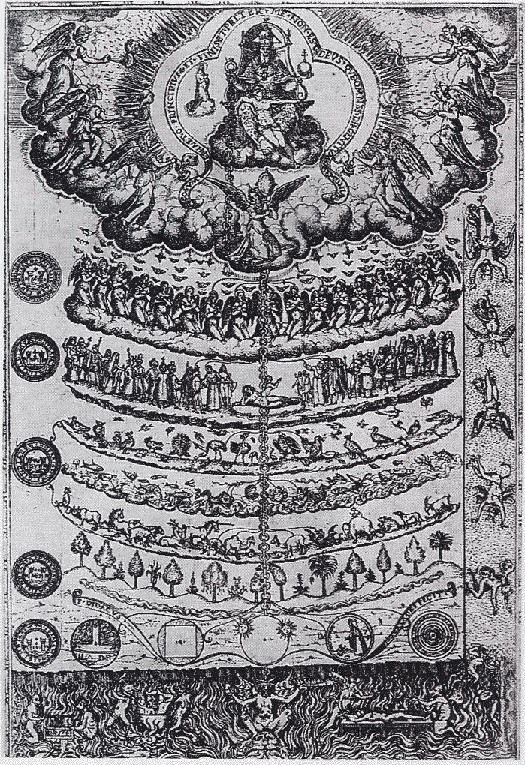
[The 1579 drawing of the great chain of being from Didacus Valades, Rhetorica Christiana]
Even though biology does not recognize a status hierarchy among living things, the “chain of being” schematic nonetheless lingers in the minds of some people, especially among people who fail to appreciate the immense biological record uncovered by dedicated scientists, the importance of the scientific method and the elegance of evolutionary theory.
Those who oppose evolution tend to be the same people who go around dissing organisms traditionally plotted lower on the chain of being diagram. A good example would be the (lack of) respect given to sponges. You can almost hear the fundamentalists spitting and hissing as they utter something like the following: “How dare those evolutionists claim that we come from sponges!”
To me, however, this reasoning does not reveal a scientific dispute, but only ignorance regarding the intimate biological relationship between humans and sponges. I find the harsh anti-evolutionary rhetoric of fundamentalists to be, essentially, anti-spongist. Since one can further trace human ancestry all the way to bacteria, I find such reasoning also anti-bacterialist. It makes me want to shout: You anti-spongists! You anti-bacterialists!
The remedy for this attitude problem of fundamentalists is that they need to take the time to honor and appreciate the complexity of “simpler” organisms. It turns out that sponges aren’t so simple. They are incredibly complex. They are a most honorable ancestor for humans. Those who allegedly oppose evolution need to appreciate the following, for instance [2]:
[It]’s with the sponge that pre-animals began to take shape, [evolutionary microbiologist Mitchell Sogin] believes, because the sponge was first to grow different cell types. For all their simplicity, sponges have “a lot of organization.” With their choanoflagellate-like choanocyte cells and a second type of cell, an archaeocyte, that can shift shape and function as needed to absorb food, secrete new skin, or reproduce, they became the first multicellular animals. All the other animals emerged from this simple architecture and are built upon this platform.
An excellent DVD set tracing human evolution from sponges is “The Shape of Life.”
The remedy for all of those rampant anti-bacterialists would be to take the time to appreciate the beauty and complexity of single-celled organisms. An elegant and detailed book addressing the complexity of single-celled organisms is The Way of the Cell, by Franklin M. Harold (2001). Consider the respect and admiration Franklin shows for the complexity of single-celled organisms and the molecules that constitute them:
One response to the question, “What Is Life?” is simply, Look around! Note the birds and butterflies, zebras and ammonites, the intricate web of life present and past, and join the unending struggle to ensure its continuance in the face of human arrogance and mindlessness . . . For the past 40 years I have been immersed in research on the biochemistry and physiology of microorganisms, with emphasis on the fundamental aspects such as bioenergetics and morphogenesis. In consequence, the central problems of life present themselves to me at the interface of chemistry and biology. How do lifeless chemicals come together to produce those exquisitely ordered structures that we call organisms? How can molecular interactions account for their behavior, growth, reproduction? How did organisms and their constituents arise on an earth that had neither, and then diversify into a cornucopia of creatures that enlivened each drop of pond water? My purpose is not to “reduce” by biology to chemistry and physics, but to gain some insight into the nature of biological order. In an earlier book, I wrote that “Living things differ from nonliving ones most pointedly in their capacity to maintain, reproduce and multiply states of matter characterized by an extreme degree of organization.” This still rings true; biological organization is the key to the nature of life, and the central theme of this book.
We must also inquire how molecules are organized into larger structures, how direction and function and form arose, and how parts are integrated into holes. Besides, we must never forget that molecules, cells and organisms are all creatures of history, brought forth by the interplay of chance and necessity. There can be no simple answer to the question, “What is life?” It is an invitation to explore the successive levels of biological reality, and a lecture on molecular biology is intrinsically no more (and no less) illuminating than a walk through the woods in the springtime.
More than half of the people in the United States claimed [3] that evolution has nothing to do with the existence and form of human animals. In my personal experience, these sorts of people despise the thought that humans are animals. I don’t think such people should be registered as opposing evolution, however. I hold this view because most “anti-evolutionists” to whom I have spoken have no understanding of what evolution actually is. Most of them claim that evolution is just a theory that says that everything here is just an accident. For this reason, honest future polls should first determine whether people really understood the scientific theory of evolution before asking them for their opinions. If this were done properly, almost all of the people currently opposed to evolution would no longer register as “opposed.” Instead, they would fall into the category “I don’t know enough about evolution to answer this question.”
Those who don’t yet have a detailed grasp of evolution need to dedicate a measly 5% of the time they spend tending to their soap operas, sporting events, sitcoms and Bible-thumping religious leaders and to reallocate this time to reading a few good books on evolution. If they would dare to do this, they would be positioned to truly understand the immensity, the grandeur and the elegance of the still-evolving human story. A good place to start would be The Ancestor’s Tale, a 2004 work in which Richard Dawkins describes human pilgrims walking back in time on trails corresponding to the evolutionary tree, passing forty rendezvous points at which the humans meet their own ancestors. It is a terrific read filled with fascinating details. One example illustrating the great power of evolution (in this example, by artificial selection) is this: taking the tamest wild silver foxes of each generation, one group of zoologists produced foxes that behaved like border collies in only 20 years!
For some, however, careful study won’t be enough. Perhaps their religious leaders have succeeded in making the topic of evolution just too toxic a thought for them [4]. Perhaps, for them, we’ll have to invoke desperate temporary “trojan horse” measures. Perhaps they could at least be enticed to pretend that tiny bacteria read tiny Bibles and worship a big bacterium in the sky on Sundays. Using that as a cognitive beachhead, we could then slowly stir in some real biology. It would be a mistake to use such a crutch for very long, however. To do so would be to miss the most spectacular story on the planet.
Although individual organisms are genetically locked in–frozen accidents–populations of organisms are always on the move, even when they appear to be sitting relatively still, like sponges. A toast, then, to our worthy ancestor, the sponge!
 [5]
[5]